Inkle vs Puzzle: which model fits how you want to run your books?



The short version
- Inkle and Puzzle aren't the same kind of product, which is why "which is better" is the wrong question. Puzzle is AI-native software you operate yourself. Inkle is software plus AI plus human bookkeepers who close your books, with tax and compliance in the same place.
- The real decision is about who owns the work. With Puzzle, the ledger and automation are excellent and the monthly close and judgment are yours (or a bookkeeper you separately hire). With Inkle, experts close the books for you on the same connected, AI-assisted system.
- Both are modern and both are strong. They suit different founders. If you want to run your own books with great tooling, Puzzle is built for that. If you want the books handled, closed, reviewed, and tax-ready, without it being your job, that's Inkle's model.
- Cost and scope differ accordingly: Puzzle is priced as software. Inkle offers a free software tier plus managed bookkeeping (from around $99/month) and files taxes off the same books.
If you're comparing Inkle and Puzzle, you've probably noticed they get lumped together, both modern, both AI-forward, both aimed at startups tired of clunky legacy accounting. That grouping hides the most important thing about the choice: they're built on different models, and the difference isn't a feature here or there. It's who does the accounting.
Get that distinction right and the decision becomes easy, because it stops being a spec-sheet contest and becomes a question about how you want to run your company's finances. This is a fair walk-through of both, where each is strongest, and how to tell which one fits.
The core difference: who owns the work
Puzzle is software you operate
It's an AI-native ledger and accounting workspace, a genuinely modern tool with strong automation, real-time dashboards, and a clean take on the general ledger. The model is that Puzzle gives you excellent software, and you drive it: you (or a bookkeeper you bring) own categorizing edge cases, closing the month, and producing the reports you need. For a founder who wants to keep a hand on the wheel with far better tooling than legacy software offers, that's the appeal.
Inkle is software plus people
It combines its own connected ledger and AI automation with expert human bookkeepers who close your books every month, on the same system. The model is that the accounting is handled for you: the software and AI do the mechanical work, and a person owns the judgment, the correct close, the odd transaction that's categorized right but makes no sense, the custom report an investor asked for, with tax and compliance running off the same books. For a founder who would rather not own the accounting at all, that's the appeal.
Neither model is universally better. They're answers to different questions. Puzzle answers "give me great software to run my own books." Inkle answers "handle my books for me, on great software." Almost everything else about the comparison follows from that one fork.
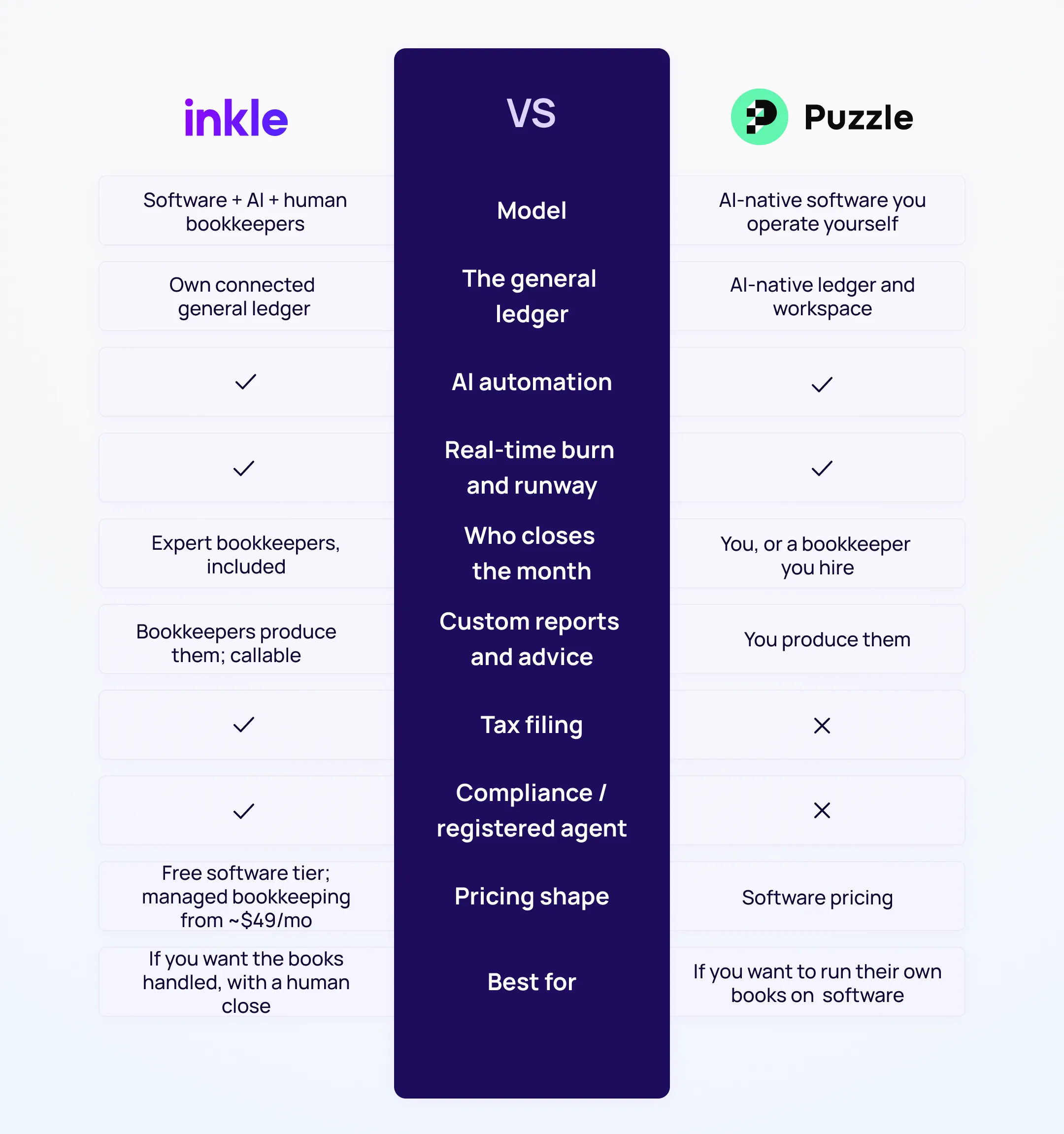
A side-by-side look
The two overlap on the basics, both give you a modern ledger, automation, and a real-time view of your finances, and diverge on the human layer and what surrounds it.
When Puzzle is the better fit
If you or someone on your team actually wants to own the books, you're comfortable in an accounting tool, you like seeing everything yourself in real time, and you don't want a service in the loop, Puzzle is built precisely for you. Its AI-native ledger is a genuinely good piece of software, and for a founder who treats bookkeeping as something they'd rather do well themselves than delegate, paying for a full managed service would be paying for something you don't want. Founders who are hands-on with finance, or who already have a capable bookkeeper and just want great software under them, are a natural fit for Puzzle. If that's you, the human layer Inkle adds is cost you wouldn't use.
When Inkle is the better fit
Most early-stage founders don't want to own their books. They want their books owned, correctly, so they can get back to building. If your reaction to "close the month" is that you'd pay not to think about it, a system where expert bookkeepers do the close on connected, AI-assisted software, and where a human is a message or a call away for a custom report or a judgment call, is doing the thing you actually want. The integrated tax matters here too: because Inkle files off the same books it keeps, your return runs on numbers that are already closed and correct, rather than exported to a separate tax provider and reconciled at the deadline. And the free software tier means you can keep live, reconciled books and real-time burn and runway from day one at no cost, adding the human layer when you want it. For founders who want automation and someone accountable for the numbers, without stitching a tool to a separately-hired bookkeeper, that combination is the point.
The honest way to choose
Answer one question: do you want to run your own books, or do you want them run for you?
If the honest answer is "I want to run them myself, just give me excellent software," lean Puzzle. If it's "I want them handled, closed, reviewed, tax-ready, without it being my job," lean Inkle. Everything else, the exact feature lists, the dashboards, the integrations, is secondary to that fork, because a product optimized for the wrong model will disappoint you no matter how good its features are. Match the model to how you actually want to spend your time, and the rest of the comparison mostly resolves itself.
Where Inkle fits, specifically
Since you're reading this on Inkle's site, here's the plain description so you can judge the fit. Inkle is built for US startups and combines three layers on one system: a general ledger connected directly to your banks, cards, payroll, and AP/AR with forecasting and live burn and runway; AI that auto-categorizes transactions and helps you read your financials; and expert bookkeepers who close your books each month, produce custom reports, and can be booked for a call. Tax and compliance filings live in the same place, so your return runs off books that are already closed and correct. A free plan covers the connected-ledger and AI layers, with managed bookkeeping starting around $49/month.
In one line: where Puzzle gives you great software to run your books yourself, Inkle gives you great software and a team that runs them for you, with tax attached. Which is right for you comes back to the one question above.
The takeaway
Inkle and Puzzle are both modern answers to startup accounting, and the choice between them isn't about which has a longer feature list. It's about a single fork: software you operate yourself, or software plus humans who operate it for you. Puzzle is an excellent tool for the founder who wants to own their books. Inkle is built for the founder who wants them owned, closed, reviewed, and tax-ready, on software just as modern. Decide which of those describes you, and you've made the decision. There's no wrong answer, only a fit.
Frequently asked questions
What's the difference between Inkle and Puzzle?
They're built on different models. Puzzle is AI-native software you operate yourself, a strong modern ledger with automation and dashboards, where you or a bookkeeper you hire own the monthly close and judgment. Inkle combines its own connected ledger and AI with expert human bookkeepers who close your books for you each month, plus tax and compliance in the same system. The core difference is who owns the accounting work: you, or an included team.
Is Puzzle or Inkle better for an early-stage startup?
Neither is universally better. It depends on how hands-on you want to be. If you want to run your own books on modern software, Puzzle is built for that. If you'd rather the books be handled, closed, reviewed, and tax-ready without it being your job, Inkle's software-plus-human model fits better. Decide whether you want to operate your books or have them operated for you, and the answer follows.
Does Puzzle include a human bookkeeper?
Puzzle's direct product is primarily AI-native software you operate yourself, so the monthly close and judgment sit with you or a bookkeeper you separately engage. Inkle's model differs: expert bookkeepers who close your books each month are part of the managed offering, working on the same connected, AI-assisted system and available for custom reports or a call. If having a human own the close matters to you, that's a key distinction.
How do Inkle and Puzzle compare on price?
Puzzle is priced as software. Inkle offers a free tier covering the connected ledger and AI layers, with managed bookkeeping starting around $99/month, and files taxes off the same books. Because the models differ, compare total value rather than headline price: software you run yourself has a lower sticker price but you own the work, while a managed layer costs more and does the work for you. Check both providers' current pricing pages, since rates change.
Does Inkle or Puzzle handle startup taxes?
Inkle files US startup taxes in the same system that keeps your books, so returns run off already-closed, correct numbers. Puzzle's focus is the ledger and close as software, so tax is typically handled through a separate provider or your own accountant. If you want bookkeeping and tax filing under one roof and in sync, that's a meaningful difference between the two.
Which is the best AI accounting platform for startups?
There's no single best. It depends on the model you want. For AI-native software you operate yourself, Puzzle is a strong choice. For software plus AI plus human bookkeepers who close your books, with integrated tax, Inkle is built for that. Both are modern and startup-focused. The right pick is the one whose model matches whether you want to run your books or have them run for you.



.webp)
.webp)