Which accounting software is best for early-stage startups?
.png)


The short version
- The honest answer to "best accounting software" is that a handful of tools are all fine for an early-stage startup. QuickBooks Online and Xero are the common defaults. The differences between them matter far less than founders assume.
- Choosing the tool is the easy 20% of the decision. The hard 80%, the part that actually determines whether your books are usable, is keeping them current, closed every month, and correct. Software doesn't do that on its own.
- So the real question isn't "which software," it's "which setup": software alone (you do the work), software plus a bookkeeping service (most early-stage startups' best fit), or a platform that combines a connected ledger, AI, and human bookkeepers in one place.
- A detail founders underrate: whether your books and your tax filing are connected. When tax prep runs off the same live books, filing is a byproduct. When they're separate, tax season becomes a reconciliation project.
"Which accounting software is best for an early-stage startup" is one of the most-searched founder questions in finance, and it has a slightly deflating answer: several of them are fine, and you won't win or lose your company on the choice. QuickBooks Online is the default most accountants and services support. Xero is its closest rival and a favourite for clean design and multi-currency. There are others. For a company with a few dozen transactions a month, any of the mainstream options will record your finances perfectly well.
That's worth saying plainly because founders spend real time agonizing over a comparison that mostly doesn't matter, and skip the part that does. Picking the tool is maybe 20% of getting startup accounting right. The other 80%, keeping the books current, closing them every month, and making sure they're actually correct, is where books succeed or fail, and no software does that part by itself. So the better framing of your question isn't "which software," but "which setup." Let's do both: the tool, quickly, and then the setup, properly.
The tools, briefly (because they matter less than you think)
Since you came for a software answer, here's the fair version, kept short on purpose.
QuickBooks Online is the safe default. It's the most widely used, which means nearly every bookkeeper, accountant, and service knows it and can plug into it, a real advantage when you later add human help or switch providers. Broad integrations, occasionally clunky, rarely a wrong choice.
Xero is the strongest alternative: cleaner interface, strong bank feeds, good multi-currency, popular outside the US. For many founders it's a nicer daily experience. Support among US accountants is narrower than QuickBooks but perfectly solid.
Others, from spreadsheets at the very bottom to more specialized ledgers, can work too. A spreadsheet used consistently genuinely beats software used twice, at very low volume. Above a trickle of transactions, a real ledger earns its place.
The tie-breaker is rarely a feature. It's what your future looks like: pick the tool your eventual bookkeeper or accounting service already supports, so adding human help later doesn't mean a migration. Which points straight at the thing that actually matters.
The real decision: not which software, but which setup
Here's the reframe worth internalizing. Software is a place to record finances. It isn't a system for keeping them right. The gap between those two is where almost every startup's accounting quietly breaks: transactions miscategorized, the close slipping by months, the books technically existing but not to be trusted. Choosing a great tool and then not maintaining it produces the same outcome as choosing a mediocre one: numbers you can't rely on when a board member, an investor, or a tax deadline asks.
So the decision that matters is the setup around the software, and there are three:
Software alone
You (or a teammate) own the whole job: connecting accounts, categorizing, reconciling, closing, and handling filings. Cheapest in dollars, most expensive in your time and risk. Viable at very low volume with genuine discipline. Fragile the moment things get busy, which is exactly when you stop keeping up.
Software plus a bookkeeping service
The tier most early-stage startups actually belong in. The software records, and a bookkeeping service reviews, closes, and keeps it correct, usually for a low flat monthly fee. You get current, trustworthy books without doing the mechanical work yourself. The catch is that stitching a standalone tool to a separate bookkeeper you email can reintroduce the seams: data moving by hand, context lost across the gap.
One platform that combines the layers
The most consolidated option: the ledger, the automation, and the human bookkeepers operate on the same data, so nothing is re-entered or reconciled twice. This is where the "which software" question dissolves. The software is one layer of a system rather than a standalone product you have to hold together.
That last option is worth unpacking, because it's what "best for an early-stage startup" increasingly means in practice.
What the strongest early-stage setup looks like: software, AI, and humans as one system
The best early-stage accounting isn't a better spreadsheet. It's three layers working on the same data, so the founder stops being the glue between tools.
Software, a connected ledger
A general ledger wired directly into where your money actually moves: banks, cards, payroll, accounts payable and receivable, with forecasting reading off the same live data. Direct connections are the whole point. They keep the books current automatically instead of relying on you to upload statements or babysit a brittle sync.
AI, the layer that handles the tedium and reads the numbers
On top of connected data, automation categorizes transactions as they arrive, flags the odd ones, and helps you actually interpret your financials: what changed, where the money went, how the month compares. AI is only as good as the data beneath it, which is why it depends on the connected ledger. Sat on clean data, it removes most of the manual labour of bookkeeping.
Humans, the judgment software can't supply
Expert bookkeepers who close the books every month on that same live data, build the custom reports a board asks for, catch the transaction that's categorized correctly but doesn't make sense, and give advice a tool can't. This is the difference between books that exist and books that are right, and it's the layer pure-software tools leave to you.
The value isn't any one layer. Plenty of products have a ledger, or AI, or a bookkeeper you can email. It's that all three run as one system on one set of data. That's the version of "accounting software" that actually solves the early-stage problem, because the problem was never recording the transactions. It was keeping the whole thing current, correct, and closed without it becoming the founder's second job.
The detail founders underrate: books and tax in the same system
One more thing separates a setup that works from one that merely exists, and almost nobody asks about it when comparing software: whether your bookkeeping and your tax filing are connected.
In the common arrangement, they're not. Your books live in one tool and your taxes are done by a separate party who, at filing time, asks for exports, finds the books aren't quite closed or quite right, and turns tax season into a reconciliation project: the same numbers assembled twice, discrepancies surfacing at the worst moment. When tax preparation instead runs off the same live, closed books, filing becomes almost a byproduct. The return is built from numbers that are already correct and already agree with everything else. No re-exporting, no "which version is right," no catch-up.
For an early-stage founder, this is the difference between tax season being a deadline you dread and a step that mostly takes care of itself. And it's a direct consequence of whether your books and your filings share a system.
How this looks in practice
This is the setup we built Inkle to be, and it maps onto everything above. On software, we built our own general ledger and connect it directly to your banks, cards, payroll systems, and AP/AR, with finance forecasting reading off that same live data, so burn, runway, and cash position stay current without anyone exporting anything. On AI, the platform auto-categorizes transactions and helps you analyze your financials rather than just store them. On humans, expert bookkeepers close your books every month on that same data, build custom reports, and give real advice. And crucially, Inkle Tax is wired to the same books, so tax prep is always in sync with your accounting, and filing runs off numbers that are already closed and correct rather than re-assembled at the deadline.
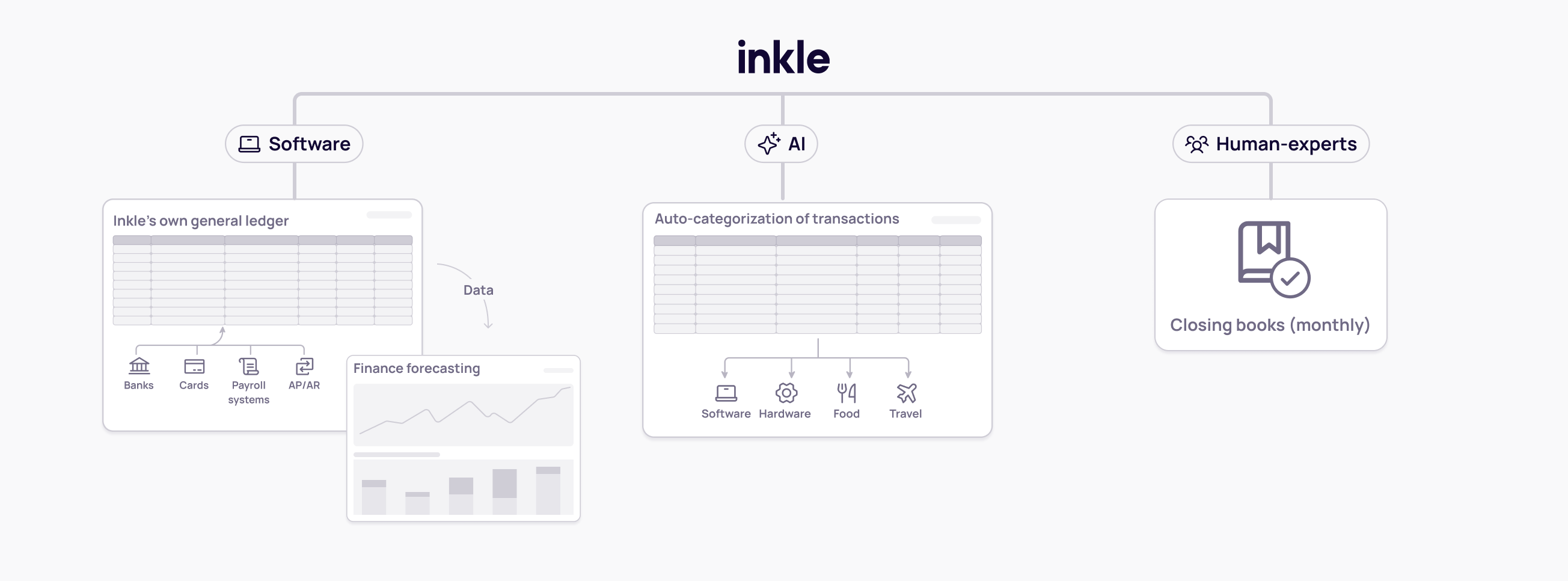
The part worth flagging for an early-stage founder: the software layer has a free plan. It includes unlimited connected bank accounts, automated data ingestion from sources like Stripe, bank reconciliation, cash and accrual financials, invoicing, rule-based and AI-suggested categorization, receipt matching, asset depreciation, multi-currency handling, and burn and runway metrics. That's the connected ledger and AI layers at no cost, so a pre-revenue startup can keep audit-ready books from day one. When you want the human layer on top, a dedicated bookkeeper closing the month and producing tax-ready financials, that's the paid monthly plan, with managed bookkeeping starting around $49/month and standard filings at published flat prices. So the same system scales with you: free while you're tiny, the human layer added when you want it, and the tax and compliance depth for high-growth companies with multi-state and international obligations when you get there.
If you have a handful of transactions and the discipline to keep up, the free software alone can be enough for a while, which is rather the point of offering it. What most companies eventually want is the combination of connected software, automation, and humans owning the close, with tax attached to the same source of truth. And because that lives in one system that starts free and extends all the way to multi-state and cross-border complexity, you grow through it rather than migrating off it. That's the version of "best accounting software" that holds up whether you're pre-revenue today or facing a diligence request and filings in five states next year.
The takeaway
Stop optimizing the 20% and neglecting the 80%. Yes, pick a solid tool. QuickBooks or Xero are safe, and the one your future bookkeeper supports is the smart tie-breaker. But the choice that determines whether your accounting actually works isn't the software. It's the setup around it: whether the books stay current, get closed every month by someone with judgment, and feed your tax filing directly instead of being reassembled at the deadline. The best early-stage accounting is three layers on one system, connected software, AI, and expert humans, with tax wired to the same books. Choose the setup, not just the software, and the tool question mostly answers itself.
Frequently asked questions
Do I need accounting software or a bookkeeping service?
Software records your finances. It doesn't keep them correct or close them each month. For most early-stage startups the best value is software plus a bookkeeping service, or a single platform combining a connected ledger, AI, and human bookkeepers, so the mechanical work is automated and a person owns the close. Software alone is viable only at very low volume and with real discipline, because the failure point is usually maintenance, not recording.
Can I just use a spreadsheet for startup accounting?
At a very low transaction count, a spreadsheet used consistently can genuinely be enough, and beats accounting software you open twice. But it scales badly: as transactions, payroll, and filings grow, a spreadsheet costs more in your time and in errors than a real ledger, and it makes tax filing and any future fundraise harder. The usual trigger to move up is rising volume or a filing you're unsure how to get right.
Should my accounting software connect to my tax filing?
Ideally yes, and it's an underrated factor. When tax preparation runs off the same live, closed books, filing is largely a byproduct built from numbers that are already correct. When books and tax live in separate systems, tax season becomes a reconciliation project: exports, mismatches, and the same numbers assembled twice at the worst possible moment. Books and filings sharing one source of truth removes most of that friction.
What should early-stage startup accounting software connect to?
Directly to your banks and corporate cards, your payroll system, and your accounts payable and receivable, with forecasting that reads off the same live data, and ideally your tax filing too. Direct connections keep the books current and eliminate re-keying. If a tool relies on manual statement uploads or brittle syncs, it leaves the stitching to you. The more of your financial sources feed one system automatically, the less accounting becomes a manual chore.