What Are the Best AI Tools for Bookkeeping in 2026


2026 is the year when AI-native bookkeeping is moving slowly from experimentation to becoming a standard practice. Startups and bookkeeping firms are looking beyond basic automation. They want clean ledgers, real-time dashboards, and tax-ready records generated continuously instead of rebuilt at month-end.
AI bookkeeping tools now go beyond simple transaction rules. Modern AI bookkeeping software combines machine learning, reconciliation engines, compliance workflows, and, in some cases, built-in expert review. The result is faster closes, clearer cash visibility, and fewer manual corrections.
To make it easier for you, we cover 5 standout AI tools for bookkeeping in 2026 in this article. For each tool, we break down core features, ideal use cases, and who benefits most, so you can choose the right bookkeeping automation stack for your setup.
To build this list, we evaluated tools based on 5 criteria:
- Depth of automation
- Real-time reconciliation capabilities
- Tax-readiness
- Multi-entity support
- Suitability for startups or firms
We reviewed product documentation, integration ecosystems, positioning, and workflow design to identify platforms that move beyond surface-level automation.
Here’s a quick overview of how the 5 tools stack up before we dive into detailed comparisons.
And now, let’s cover each tool in detail, including core features, common use cases, and who should consider it in 2026.
1. Inkle: Built for US Startups and Global Founders
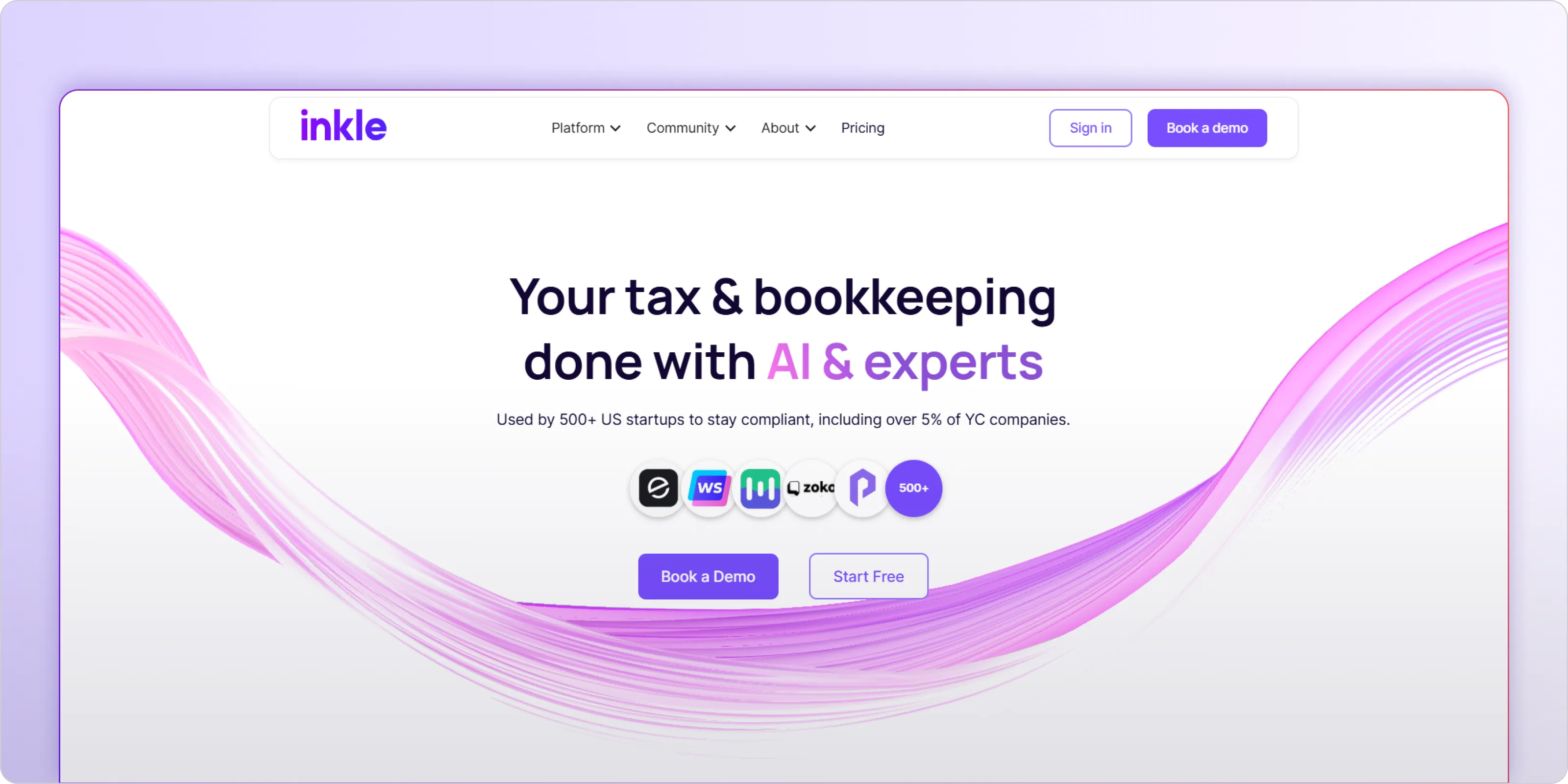
Inkle is purpose-built for US startups, Delaware C-corps, LLCs, and global founders operating cross-border structures. Instead of offering standalone AI bookkeeping software, it combines bookkeeping automation, US tax filings, and firm management into a single connected stack. This removes the friction between maintaining books and preparing tax returns.
What makes Inkle different from generic bookkeeping automation tools is the workflow continuity. Bookkeeping data does not sit in isolation. It flows directly into tax preparation and compliance tracking. Automation reduces repetitive work, while structured review ensures financial accuracy and regulatory alignment.
Below are the core capabilities that make Inkle a strong AI-native bookkeeping and tax platform for startups and firms:
- Inkle Books: Automated transaction categorization, real-time cash tracking, continuous reconciliation, and built-in 1099 workflows.
- Inkle Tax: AI-assisted preparation of US business returns and filings using ledger-linked financial data.
- Inkle Practice: A firm operating system with filing calendars, automated reminders, document collection workflows, and autofill capabilities.
- Ecosystem Integrations: Direct connections with tools like Gusto, Stripe, Mercury, and other startup finance platforms to ensure clean data flow.
Common Use Cases
Inkle is often used by startups that want a unified bookkeeping and tax system instead of stitching together multiple tools. Rather than managing bookkeeping software separately from tax filings, founders operate within one structured workflow.
These are the most common ways startups and firms apply Inkle in real-world finance operations:
- Managing automated bookkeeping and reconciliation for Delaware C-corps
- Handling contractor payments and 1099 filings directly from structured records
- Supporting cross-border founders running US and other entities
- Preparing investor-ready financial statements without rebuilding reports manually
- Enabling small firms to manage multiple startup clients through standardized workflows
Best For
Inkle is best suited for US C-corps and LLCs that need integrated bookkeeping and tax support in one platform. It works particularly well for global founders who want automation paired with structured human oversight.
It is also suitable for small bookkeeping firms serving startups, especially those looking to replace fragmented tools with a centralized AI-native finance stack.
2. Zeni: Finance Team + AI in One Stack
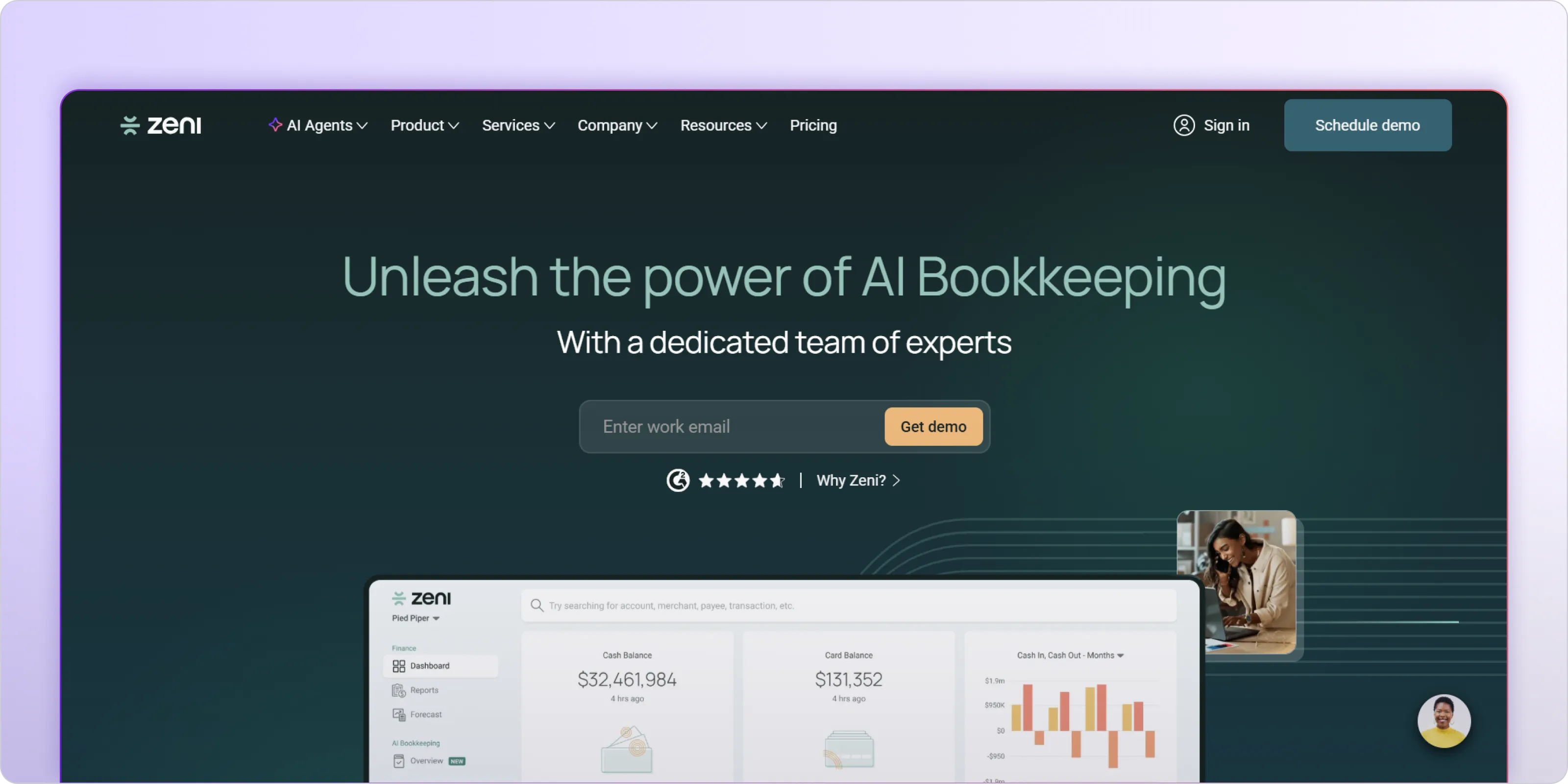
Zeni positions itself as a combination of AI automation and an embedded finance team. Instead of offering only bookkeeping automation tools, it layers human accountants and finance professionals on top of its AI-driven bookkeeping engine. This appeals to funded startups that want both software and ongoing financial oversight without hiring a full internal team.
The platform focuses heavily on real-time visibility. Founders get live dashboards tracking cash balance, burn rate, and runway. Behind the scenes, AI handles transaction categorization and reconciliation, while finance experts review outputs and assist with reporting. The model works well for companies prioritizing speed and decision-ready metrics.
The following features explain how Zeni combines AI automation with an embedded finance team model:-
- Real-time financial dashboards: Live tracking of revenue, expenses, burn, and runway to support faster decisions.
- Automated categorization and reconciliation: AI processes bank feeds and transactions continuously instead of batching at month-end.
- Human finance layer: Dedicated bookkeeping professionals review books and support reporting needs.
- Outsourced finance operations: Combines bookkeeping and finance management into a single service structure.
Common Use Cases
Zeni is typically adopted by funded tech startups that want a plug-and-play finance function. Instead of building an in-house team early, they rely on a combined AI and outsourced model.
In practice, companies typically use Zeni in the following scenarios:
- Managing books while tracking live burn and runway
- Preparing investor updates based on real-time dashboards
- Handling growing transaction volumes after raising capital
- Replacing early-stage manual bookkeeping setups
Best For
Zeni works best for startups that prioritize real-time metrics and want a bundled finance solution. It is particularly suitable for companies in rapid growth phases where hiring a full internal finance team may not yet be practical.
It may be less suited for founders who prefer a modular stack or want to separate bookkeeping automation from advisory services.
3. Integra Balance AI: Configurable Automation for Firms
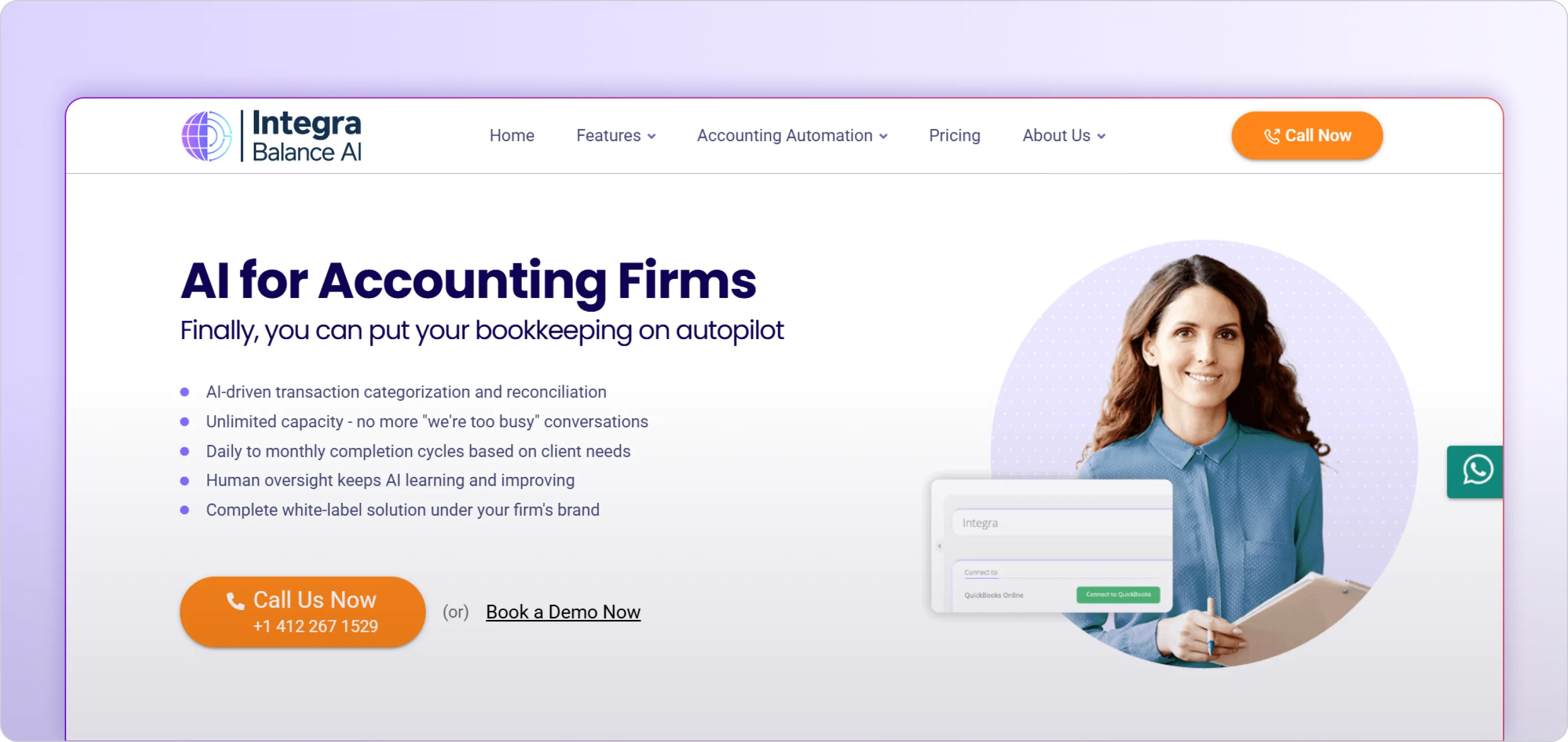
Integra Balance AI focuses on configurable automation rather than a fixed workflow model. It is designed for bookkeeping practices and mid-sized businesses that want to modernize operations without fully replacing their existing systems. The emphasis is on adapting automation to firm-specific processes rather than enforcing a rigid template.
This flexibility appeals to firms that already have established workflows but want to introduce AI-driven bookkeeping software gradually. Instead of overhauling their stack, they layer automation into reconciliation, transaction processing, and reporting.
The platform’s core features focus on configurable automation for firms modernizing their accounting workflows:-
- Bookkeeping automation with live reconciliation: Transactions are processed and matched continuously instead of batched monthly.
- Configurable workflows: Firms can tailor automation rules and approval layers based on their internal structure.
- Multi-client support: Designed to manage several client books while maintaining standardized oversight.
- Integration-ready architecture: Works alongside existing bookkeeping platforms without requiring full migration.
Common Use Cases
Integra Balance AI is often used by bookkeeping firms modernizing legacy processes. Instead of switching platforms entirely, they introduce AI-driven categorization and reconciliation into specific parts of their workflow.
Here are the typical situations where firms implement Integra Balance AI:-
- Automating high-volume transaction processing
- Reducing manual reconciliation time across multiple clients
- Implementing standardized exception handling processes
- Supporting hybrid teams that combine automation with manual review
Best For
Integra Balance AI works best for bookkeeping practices and mid-sized businesses seeking customizable bookkeeping automation tools. It is particularly suitable for teams that want flexibility in how AI is applied rather than a fully bundled finance stack.
It may not be ideal for founders looking for an all-in-one bookkeeping and tax solution tailored specifically to startups.
4. Booke AI: Lightweight AI Assistant for Bookkeepers
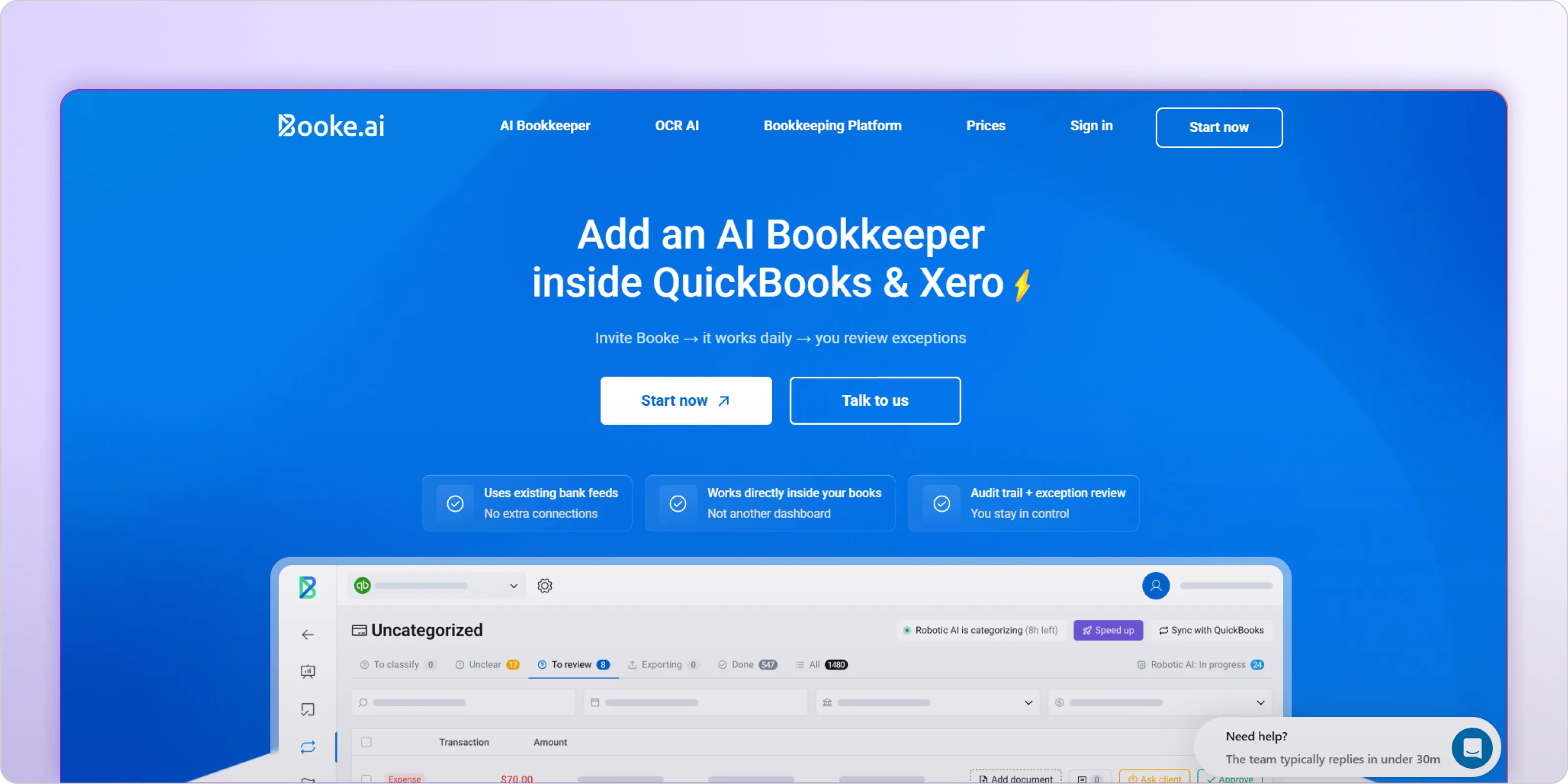
Booke AI positions itself as an AI assistant layered on top of existing bookkeeping systems, particularly Xero and QuickBooks Online. Instead of replacing your ledger, it focuses on cleaning up transaction data, resolving coding inconsistencies, and reducing reconciliation backlog.
The tool is lightweight compared to full finance stacks. It is designed for bookkeepers who already operate within Xero-based environments and want to automate repetitive classification and exception handling without migrating platforms.
Here are the key features that make Booke AI a practical assistant for Xero and QuickBooks-based bookkeeping setups:-
- AI-powered transaction classification: Automatically categorizes transactions from invoices, receipts, and bank feeds based on learned patterns.
- Reconciliation and exception handling: Identifies unmatched or unusual transactions and presents them in a structured review queue.
- Backlog clean-up automation: Helps firms process historical uncategorized entries more efficiently.
- Bookkeeper-focused interface: Streamlined dashboard designed for reviewing flagged items quickly.
Common Use Cases
Booke AI is typically used by small firms and independent bookkeepers managing multiple Xero clients. Instead of manually coding every transaction, they use AI to process routine entries and focus on reviewing flagged exceptions.
Bookkeepers and small firms most often use Booke AI in the following cases:-
- Cleaning up months of uncategorized transactions
- Automating recurring expense coding
- Reducing time spent on bank reconciliation
- Supporting small businesses with limited bookkeeping staff
Best For
Booke AI works best for small businesses, freelancers, and bookkeeping firms heavily invested in Xero or QuickBooks Online. It is particularly useful when the goal is to automate bookkeeping tasks without replacing the existing bookkeeping system.
It may be less suitable for startups seeking a unified bookkeeping, tax, and compliance stack within one platform.
How to Choose the Right AI Bookkeeping Tool for Your Business?
Before even getting started, you need to ask yourself these questions:-
- Are you a US startup needing integrated bookkeeping and tax support?
- Are you a venture-backed company prioritizing live cash metrics?
- Are you a bookkeeping firm scaling across multiple clients?
And once you have answers to these questions, here is a practical way to narrow your decision:
- Choose Inkle if you need a unified bookkeeping, tax, and practice platform built for US C-corps or LLCs. It works well for startups that want structured automation combined with compliance oversight in one stack.
- Choose Zeni if you prefer AI plus an outsourced finance layer and prioritize real-time burn, runway, and performance dashboards. This is often suitable for funded startups scaling quickly.
- Choose Botkeeper or Integra Balance AI if you operate an bookkeeping firm and need scalable, multi-client workflows with automation layered into reconciliation and categorization.
- Choose Booke AI if your setup is Xero or QuickBooks-heavy and you want to automate transaction coding, clean up backlogs, and streamline exception handling without migrating systems.
The right choice depends on how integrated you want your stack to be. Some teams prefer modular tools layered onto existing systems. Others benefit from an AI-native bookkeeping stack that connects bookkeeping, tax, and reporting from the start.
How Inkle Supports AI-Native bookkeeping
Inkle is structured for startups that want AI tools for bookkeeping without assembling multiple disconnected systems. It connects directly to bank feeds, payment processors, payroll platforms, and bookkeeping ledgers. Transactions are categorized automatically, reconciliations run continuously, and financial records stay updated throughout the month.
For small bookkeeping firms, the platform reduces repetitive bookkeeping work while maintaining structured oversight. Instead of spending time correcting ledger inconsistencies, teams review flagged exceptions and focus on higher-value financial analysis. Automation handles routine processing, while professionals maintain accountability.
Inkle combines bookkeeping automation, tax preparation workflows, and firm management tools into one system.
- Real-time categorization with AI: Transactions are automatically coded and reconciled using machine learning models that improve over time.
- CPA-reviewed tax filings: Ledger data flows directly into US business returns and compliance workflows, reducing manual compilation.
- Firm OS tools for multi-client management: Filing calendars, automated reminders, document collection workflows, and task tracking help firms operate efficiently.
If you are evaluating AI bookkeeping software or broader bookkeeping automation tools, consider whether your current stack connects bookkeeping, tax, and reporting in a structured way.
Book a demo with Inkle to simplify books, taxes, and practice management in one AI-powered platform.
Frequently Asked Questions
What are AI tools for bookkeeping?
AI tools for bookkeeping use machine learning and automation to categorize transactions, reconcile accounts, detect anomalies, and assist with financial reporting and tax preparation. Instead of relying entirely on manual entry, these systems process financial data continuously and flag exceptions for review.
Can AI fully handle my startup’s bookkeeping?
Most modern AI bookkeeping software can handle 80 to 90 percent of routine tasks such as transaction coding, receipt capture, and reconciliation. However, human review remains important for edge cases, unusual transactions, compliance checks, and tax filings.
Are these tools safe for sensitive financial data?
Leading vendors use encrypted cloud infrastructure, role-based access controls, and structured audit trails to protect financial records. Many also follow SOC 2 compliance standards to meet enterprise and investor security expectations.
Which tool works best with QuickBooks or Xero?
Inkle, Booke AI, and Botkeeper integrate with QuickBooks Online and Xero. The right choice depends on how much automation and workflow depth you need. Some tools focus on transaction cleanup, while others offer integrated bookkeeping and tax support.
Can these tools replace my CPA?
No. AI tools streamline bookkeeping and reporting preparation, but professional review is still important for compliance, tax planning, and audit readiness. Automation improves efficiency, while CPAs provide judgment and oversight.


