What to Do When Your Startup Receives an IRS Notice



An IRS notice can feel like a fire alarm. Before you panic, here is the truth: most notices are routine, resolvable, and far less catastrophic than they look at first glance.
You are heads-down building your product, closing your next round, or onboarding your first enterprise customer. Then a letter arrives from the Internal Revenue Service. The IRS letterhead alone is enough to spike cortisol. But experienced founders and CFOs know the IRS sends millions of notices every year, and the vast majority require nothing more than a calm, organized response.
This guide walks you through exactly what to do, from the moment you open the envelope to the moment the issue is resolved. It is written for early-stage US startups, including Delaware C-Corps backed by venture capital, where compliance stakes are high and internal finance teams are often lean.
Step 1: Do not ignore it
This sounds obvious, but a surprising number of founders set IRS letters aside during a fundraising sprint or product launch. That is how a minor administrative issue becomes a tax lien, a penalty cascade, or a flag that derails your next round of due diligence.
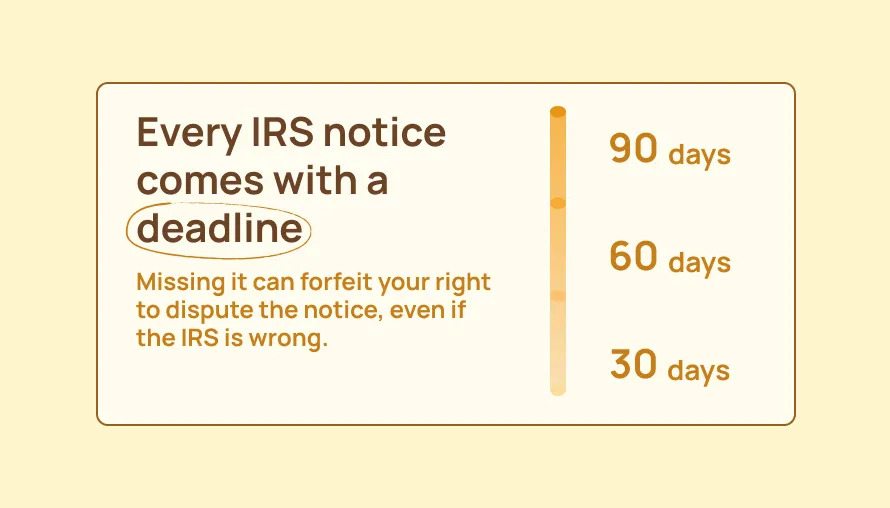
Open it, scan it, and log the response deadline in your calendar the same day it arrives.
Step 2: Identify what type of notice it is
Every IRS notice has a notice number printed in the upper right corner. This tells you exactly what the IRS wants. The most common ones startups encounter:
- CP2000: Income or payments reported by third parties do not match your return. Very common. Often fixable with documentation
- CP11 / CP12: The IRS changed your return and believes you owe more tax (or they owe you a refund). Review their math carefully
- LT11 / Letter 1058: Final notice of intent to levy. Serious. Requires immediate action
- Notice 504: Urgent notice about an unpaid balance. A levy may be imminent
- CP501 / CP503 / CP504: Escalating balance due reminders. Act before they escalate further
- Letter 2205 / 2205-A: You have been selected for an audit. Do not respond without counsel
Look up your notice number on IRS.gov. The IRS publishes plain-English summaries of every notice type. This five-minute step will tell you whether you are dealing with a paperwork mismatch or something that needs a tax attorney.
Step 3: Read the notice carefully before doing anything
IRS notices follow a structured format. You will find the tax year in question, the specific issue identified, the amount owed (if any), and the requested response. Before you call anyone, read it fully, twice.
.webp)
Founders often confuse personal tax notices with business ones. If you have recently restructured your cap table, issued stock options, or completed a Section 83(b) election, verify that the notice relates to the right taxpayer and EIN before assuming liability.
Step 4: Pull your records
Gather the documentation relevant to the tax year and issue in question. This typically includes your filed tax return (Form 1120 for C-Corps), any amended returns, payroll filings, W-2s and 1099s issued, bank statements, cap table records, and any prior IRS correspondence.
If your startup uses a bookkeeping or tax platform, pull the source-of-truth data from there. If your books are messy or behind, this is the moment you will feel that pain most acutely. It is also a good reminder that clean, up-to-date financials are not optional for startups going through fundraising or acquisition diligence.
%20(1).webp)
Step 5: Involve your tax advisor immediately
Do not draft a response on your own unless the notice is purely informational (like a CP501 balance reminder you are going to pay in full). For anything involving a proposed tax change, a penalty, an audit, or a levy notice, loop in a CPA or tax attorney before you respond.
Your response to the IRS is a legal document. An incorrect or incomplete response can lock you into a position that is harder to unwind later. A good tax advisor will know whether to agree, dispute, or request more time and how to frame each option correctly.
If you work with a startup-specialized finance platform or fractional CFO, start that conversation now. The earlier they are involved, the more options you have.
Step 6: Respond formally and on time
Send every IRS notice response via certified mail with return receipt requested. This gives you proof of the postmark date and confirmation of receipt, both of which matter if there is ever a dispute about timeliness.
- Reference the notice number and tax year in your response letter
- Attach copies (never originals) of all supporting documents
- Be factual and brief. Do not over-explain or volunteer unrequested information
- Keep a complete copy of everything you send
- Log the certified mail tracking number and expected delivery date
If you need more time, you can call the IRS and request an extension. Many notices allow this, though it is not guaranteed. Get the agent's name and ID number if you do.
Step 7: Follow up and confirm resolution
Sending your response does not close the loop. IRS processing times range from 30 days to several months depending on the notice type and current volume. Set a calendar reminder to follow up if you have not received a written response within 60 days.
Once the IRS confirms the issue is resolved (by letter, by zeroing out your balance, or by closing an audit), file that confirmation with your permanent tax records. If the same issue resurfaces in a future year, you will want the paper trail.
The underlying lesson
IRS notices are rarely the end of the world. Founders who handle them worst are the ones who panic and respond hastily, or ignore them and hope they go away. Founders who handle them best treat them like any other business problem: understand it clearly, get the right people involved, respond methodically.
The best version of this story is the one where notices are rare, because your payroll filings are on time, your 1099s are accurate, your books reconcile cleanly, and your tax returns reflect your actual financial position. That is what proper startup financial infrastructure buys you: not just reports, but peace of mind when the IRS does decide to knock.
.webp)
Read more: How to spot a fake IRS notice