Multi-State Compliance for Startups: A Founder's Guide to Staying in Good Standing



Most founders think about state compliance exactly twice: when they incorporate in Delaware, and when a penalty notice arrives. In between, the company quietly becomes a multi-state business. It hires an engineer in Austin. It stores inventory in a Nevada warehouse. It crosses $100,000 in sales into Illinois. None of those moments feel like a compliance decision at the time. They feel like growth. But every one of them creates an obligation in a new state.
That's the defining feature of state compliance: it scales silently with the business. The filings themselves are cheap and mostly routine. The failure modes are not. A lapsed registration can make a contract unenforceable in the state where you need to enforce it, stall a financing round in diligence, or surface years later as a six-figure back-tax liability. Remote work and post-Wayfair sales tax rules mean that almost every growing company is now operating in multiple states, often without having decided to.
This guide covers what states actually require, what quietly triggers a new obligation, what it costs when things go wrong, and how to keep it all under control as you scale.
Key takeaways
- You owe compliance where you have nexus, not where you have customers. Physical presence (an employee, an office, inventory) and economic presence (crossing a state's sales threshold) are the two things that create obligations.
- One remote hire is usually enough. A single employee working in a state generally requires you to register the entity there and register for state payroll taxes.
- Delaware incorporation is not permission to operate everywhere. It establishes your legal existence. You must separately foreign qualify in each state where you do business.
- The direct cost is small. The risk is not. Franchise taxes and report fees run a few hundred dollars per state, but losing good standing can block fundraising, M&A, and your ability to sue.
- Deadlines are scattered across the calendar and across agencies, which is precisely why spreadsheets fail. Delaware corporations file by March 1. California runs on your incorporation anniversary. Sales tax returns can be monthly.
What "state compliance" actually means
Every business has a home state, the one where it incorporated (for most venture-backed startups, that's Delaware). Every other state where the company does business is a foreign state, in the legal sense of "foreign to your state of formation," not international.
In each state where you operate, you can expect to owe up to four things:
- Entity registration (foreign qualification). Formal permission to do business in a state other than your home state. A successful filing produces a Certificate of Authority.
- A registered agent. A person or company with a physical address in that state, designated to receive legal notices and official state mail on your behalf. Every US state requires one.
- An annual report and state entity tax. A periodic filing that keeps your registration current, usually paired with a franchise tax or fee.
- Tax registrations. Separate registrations for payroll taxes (if you employ people there) and sales tax (if you sell enough there).
These are administered by different agencies, on different schedules, and a company can be perfectly compliant on one and delinquent on another without any single dashboard telling it so.
What actually triggers a new-state obligation?
The concept that governs all of this is nexus, a sufficient connection between your business and a state to give that state the right to regulate and tax you. There is no single national definition of "doing business." It's a facts-and-circumstances question decided state by state. But nexus comes in two broad forms.
Physical presence
Physical nexus is created by a tangible connection to the state. The common triggers:
- Employees, including a single remote worker living and working in the state. This is the trigger that catches startups most often.
- An office, store, or other property.
- Inventory, including stock held in a third-party or fulfillment warehouse (for example, an FBA warehouse).
- In some states, traveling salespeople or certain contractors.
Physical presence typically requires you to foreign qualify and register for state payroll taxes, including state income tax withholding and state unemployment insurance.
Economic presence
Economic nexus is created by selling enough into a state, even with no physical presence there at all. This is the world created by the US Supreme Court in South Dakota v. Wayfair (June 21, 2018), which overturned the decades-old rule that a state could only tax sellers with physical presence. Today every state that has a sales tax also has an economic nexus law.
The template most states copied from South Dakota is $100,000 in sales into the state in the current or previous calendar year, in many states or 200 separate transactions. Two things founders should know:
- The transaction count is disappearing. As of early 2026, at least 16 states, including California, Illinois, and Washington, have dropped the 200-transaction test in favor of a pure revenue threshold. Illinois removed it on January 1, 2026. Kentucky follows on August 1, 2026. This simplification generally helps small sellers, who could previously trip a threshold on volume without meaningful revenue.
- The thresholds are not uniform. Connecticut uses an "and" test ($100,000 and 200 transactions). New York sets its bar at $300,000 and 100 transactions. Most others use a simple "or." Always check the specific state.
Crossing an economic threshold requires you to register for and collect sales tax, and critically, the exposure runs from the day you crossed the line, not the day you noticed.
The four registrations, in practice
Here's what each obligation looks like in the real world, using the two states nearly every US startup encounters: Delaware, where it incorporates, and California, where it so often first operates.
1. Foreign qualification
You file with the target state's Secretary of State for a Certificate of Authority, usually attaching a certificate of good standing from your home state and appointing a registered agent. The principle is simple and worth repeating: being a Delaware C-Corp does not authorize you to operate in California, New York, or anywhere else. Delaware governs your existence. Each operating state governs your right to do business there.
2. Registered agent
Every state requires you to maintain a registered agent with a physical street address in that state (a PO box won't do) during business hours. As you expand into more states, this is the piece most likely to fragment: a different agent in each state, official notices arriving at addresses no one checks. Consolidating registered agent service is one of the highest-leverage simplifications available, because it routes every state's legal mail to one place.
3. Annual reports and franchise tax
This is where the calendar gets genuinely tricky, because the obligations differ by state, by entity type, and by whether you are the home entity or a foreign registrant.
A few details that trip people up. Delaware's franchise tax maxes out at $200,000 (or $250,000 for a "Large Corporate Filer"), and the figure depends heavily on your authorized share count and the calculation method. Many startups overpay simply by using the wrong method. Delaware also imposes a separate obligation on foreign corporations qualified there: an annual report and a $125 fee due June 30. On the California side, the $800 minimum franchise tax and the Statement of Information go to two different agencies (the Franchise Tax Board and the Secretary of State), and newly formed corporations are exempt from the minimum tax in their first taxable year, but LLCs formed on or after January 1, 2021 are not and generally owe the $800 in year one.
4. Payroll and sales tax registration
The moment you employ someone in a state, you generally register for state income tax withholding and state unemployment insurance. The moment you cross an economic nexus threshold, you register for sales tax. Two nuances matter for tech startups specifically: sales tax nexus can be triggered by inventory you don't think about (goods sitting in a 3PL warehouse), and whether your product is taxable is a separate question from whether you have nexus. SaaS is taxed in some states and not others, so crossing a threshold means you must register and then determine taxability, not automatically start charging tax.
The cost of getting it wrong
The reason compliance deserves a founder's attention is not the filing fees. It's the asymmetry: routine costs on one side, disproportionate consequences on the other.
Penalties and back fees accrue retroactively. States fine unregistered businesses anywhere from a few hundred to $10,000 or more, plus every missed report, franchise tax, and interest charge dating back to when you should have registered. California can assess penalties reaching roughly $2,000 per year of non-compliance on top of taxes and interest, and under the California Corporations Code, an individual who knowingly transacts business on behalf of an unregistered foreign corporation can even be guilty of a misdemeanor.
You lose the right to enforce your own contracts. This is the consequence founders least expect. An entity that isn't qualified where it's doing business generally cannot bring a lawsuit in that state's courts until it registers and pays all back fees. Your contracts remain valid and you can still defend yourself in a suit, but you can't affirmatively sue to collect. In Drake Manufacturing Co. v. Polyflow, Inc. (Pennsylvania, 2015), a company was barred from pursuing its own lawsuit entirely because it hadn't obtained a certificate of authority. In practical terms: a Texas marketing agency that expanded into Colorado without registering couldn't sue a Denver client over an unpaid $25,000 invoice until it foreign qualified and paid roughly $3,500 in back penalties.
Loss of good standing blocks the things that matter most. A lapsed filing puts your entity out of good standing, and that status is checked at exactly the wrong moments: when you raise a round, take on debt, get acquired, or open a bank account. You cannot obtain a certificate of good standing from a state where you owe taxes or reports, and Delaware will void a corporation's charter altogether after more than a year of non-compliance.
Unpaid sales tax becomes a diligence problem. Uncollected sales tax doesn't disappear. It sits as an accrued liability that grows with interest and surfaces during fundraising or acquisition diligence, where buyers routinely discount valuation or escrow funds to cover it. A tidy $50,000-a-month e-commerce business that quietly crossed nexus in a dozen states can carry a very untidy liability into its Series A.
A playbook for scaling compliance without a back office
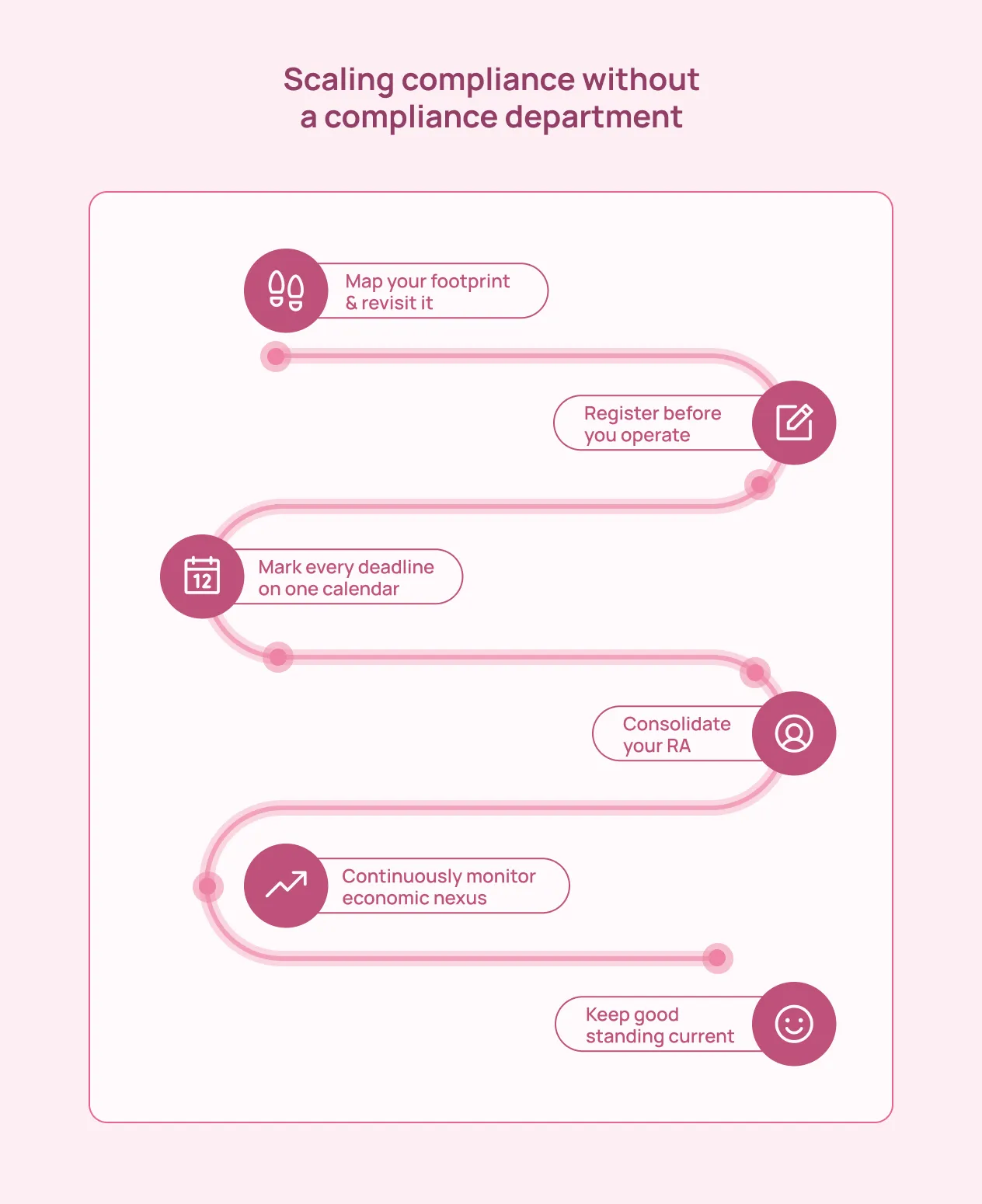
You don't need a compliance department. You need a system. In practice, compliance maturity moves through three stages: reactive (responding to penalty notices), organized (a single calendar and clear ownership), and automated (a platform that tracks obligations and files for you). Here's how to get to the second stage fast and set up for the third.
- Map your footprint, and revisit it quarterly. For each state, ask three questions: do we have people here, property or inventory here, or meaningful sales here? The answers tell you where you already have obligations and where you're about to.
- Register before you operate, not after. Foreign qualify and set up payroll registration before an employee's first day or a warehouse's first shipment. Prospective registration costs a filing fee. Retroactive cure costs back taxes, penalties, and interest.
- Put every deadline on one calendar. These dates are deliberately scattered: Delaware corporations on March 1, California on your anniversary month, Delaware foreign registrants on June 30, sales tax returns often monthly. A distributed set of obligations is the single biggest reason teams relying on memory and email eventually miss one.
- Consolidate your registered agent. One agent across all states means official notices arrive in one place, on time, instead of scattered across addresses you don't monitor.
- Monitor economic nexus continuously. Re-check your sales against each state's threshold as revenue grows, and note the ongoing repeal of transaction-count tests. The rules are moving in your favor, but only if you're tracking them.
- Keep good standing current ahead of any raise or deal. Don't wait for an investor's diligence checklist to discover a delinquent report. Pull a certificate of good standing in your key states before you need it.
Frequently asked questions
Do I need to register my business in every state where I have customers?
No. Having customers in a state does not, by itself, create an obligation. You register when you have nexus: physical presence (an employee, office, or inventory) generally requires entity and payroll registration, and crossing a state's sales threshold requires sales tax registration.
Does hiring one remote employee mean I have to register in their state?
Usually, yes. A single employee working in a state generally creates physical presence, which typically means you must foreign qualify there and register for state income tax withholding and unemployment insurance.
I'm a Delaware C-Corp. Do I still need to register in California?
Yes, if you're doing business in California, for example if you have an office or employees there. Delaware incorporation establishes your entity's legal existence. It does not authorize you to operate in other states. You foreign qualify in each state where you actually do business.
What's the difference between a registered agent and foreign qualification?
Foreign qualification is the registration that gives your entity permission to do business in a state (the Certificate of Authority). A registered agent is the in-state point of contact designated to receive legal and government mail. You generally need both in every state where you operate.
What happens if I miss an annual report deadline?
First, late fees and interest. Delaware charges a $200 penalty plus 1.5% monthly interest. Then loss of good standing. Then, if the lapse continues, administrative suspension or, in Delaware, voidance of your charter after more than a year. The longer it runs, the more expensive and disruptive the cure.
How much does multi-state compliance actually cost per year?
The direct cost per state is modest, often a few hundred dollars in franchise tax and report fees, plus registered agent service. It compounds as you add states and tax types, but the dominant cost is almost never the fees. It's the risk and cleanup associated with getting it wrong.
Do SaaS companies owe sales tax?
Sometimes. Whether software-as-a-service is taxable depends entirely on the state. Some tax it, many don't. But economic nexus applies regardless: once you cross a state's sales threshold, you must register there and then determine whether your specific product is taxable.
What is a certificate of good standing, and when do I need it?
It's an official document confirming your entity is properly registered and current on its state filings. You'll need it for financing, acquisitions, opening bank accounts, and some foreign qualifications and licenses, and you cannot obtain one from a state where you owe taxes or reports.
Bringing it together
Multi-state compliance isn't hard the way building a product is hard. It's hard the way a hundred small, time-sensitive, easy-to-forget obligations spread across a dozen agencies is hard. The companies that stay in good standing aren't the ones with the most lawyers. They're the ones that treat compliance as a system: a single view of every state, every deadline, and every registration, updated as the business grows.
That's exactly the gap Inkle's State Compliance is built to close. Add each state you operate in and it tracks your registrations, deadlines, and registered agent in one place, flags what needs attention before it becomes a penalty, and files the paperwork for you, so growing into a new state stays a growth decision, not a liability.


.webp)
