What is California Form 100? What Should Delaware C-Corp Startups Know?



California Form 100 is the state return C-corporations use to report California franchise tax or corporate income tax. A Delaware C-corp may need to file it if the company is incorporated, registered, qualified, or doing business in California. This can include California founders, employees, payroll, customers, property, or operations.
For example, a Delaware C-corp with a founder working from Los Angeles and California payroll may need to file Form 100 even though the company was not incorporated in California. Missing this filing can lead to penalties, interest, FTB notices, and diligence issues during fundraising. This article explains when Form 100 applies, what it reports, key due dates, e-filing options, and how startups can stay ready before tax season.
What Is California Form 100?
California Form 100 is the state tax return used by C-corporations to report California franchise tax or corporate income tax. The California Franchise Tax Board lists it as the California Corporation Franchise or Income Tax Return, which means it is the main corporate return for C-corps with California filing obligations.
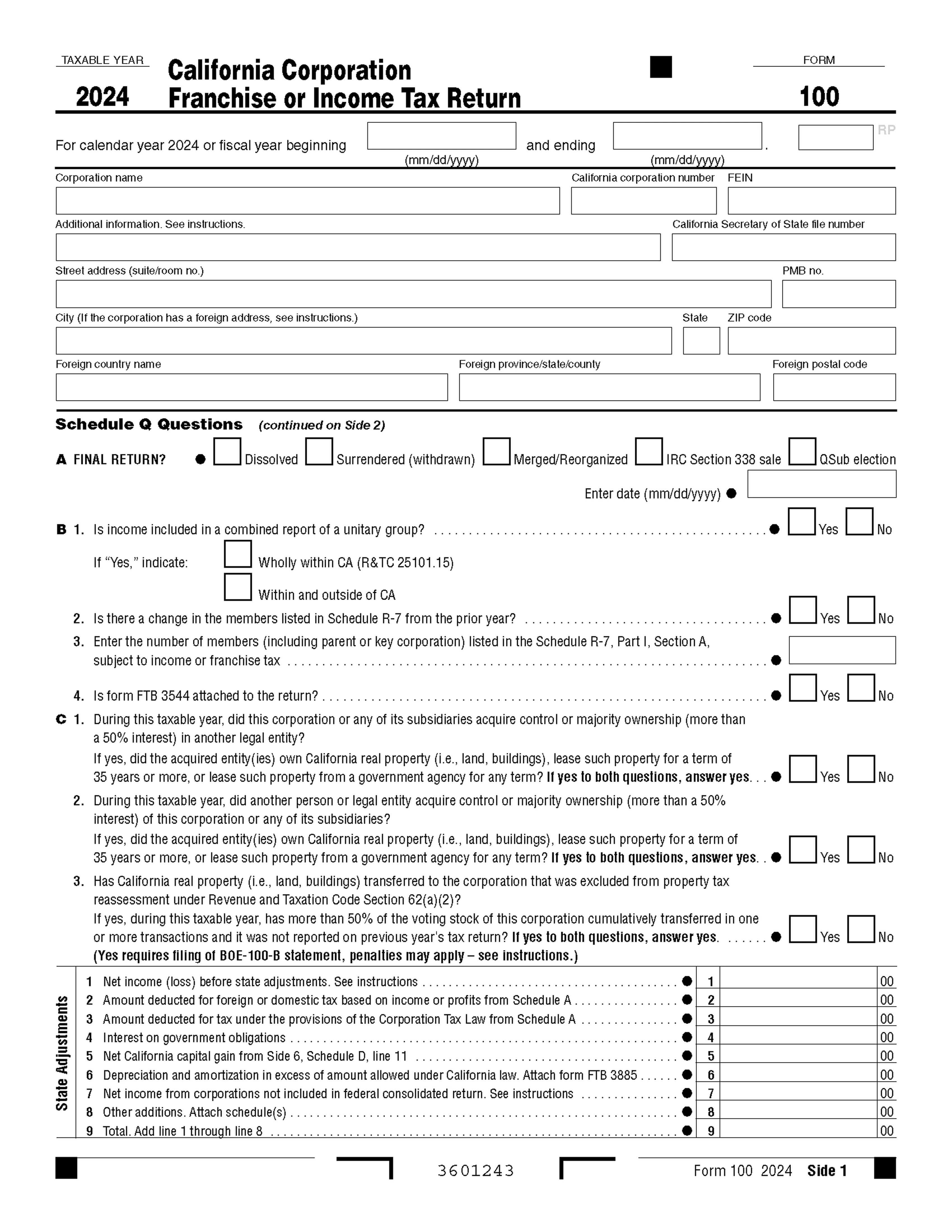
For Delaware C-Corp startups, Form 100 becomes relevant when the company has a California connection. This could be because the company is registered in California, qualified to do business there, or has operations, employees, revenue, or management activity tied to the state.
California Form 100 helps report:
- California taxable income.
- California apportionment for multistate businesses.
- The $800 minimum franchise tax.
- Tax payments, credits, and balances due.
Why Form 100 Matters for Delaware C-Corp Startups
Form 100 matters because Delaware incorporation does not block California tax obligations. If the company operates in California or creates California nexus, the state may still expect the startup to file, pay, and maintain records with the California Franchise Tax Board.
Common California triggers include:
- Founders working from California.
- California employees or contractors.
- A California office, coworking space, or business address.
- California customers or revenue.
- California Secretary of State foreign corporation registration.
Who Must File California Form 100?
A corporation may need to file California Form 100 if it is incorporated, registered, qualified, or doing business in California. For Delaware C-Corps, the most common reason is not incorporation. It is California activity. A startup may be legally formed in Delaware but still have California filing duties because its founder, team, revenue, payroll, or operations are connected to the state.
.webp)
The California Franchise Tax Board generally expects corporations incorporated, registered, or doing business in California to pay the $800 minimum franchise tax unless an exception applies. Once a Delaware C-Corp has a California filing obligation, Form 100 can become an annual requirement, even if the company is early-stage or loss-making.
A Delaware C-Corp should review Form 100 filing requirements if it:
- Has a California founder actively working for the company.
- Employs people in California.
- Pays California contractors for operational work.
- Has California-source revenue.
- Owns or leases California property.
- Registered as a foreign corporation in California.
- Received an FTB notice.
What Doing Business in California Means
“Doing business” in California can include actively carrying out transactions for financial gain in the state. For startups, this may include hiring employees, managing operations, selling to California customers, holding property, or running part of the business from California. The exact answer depends on facts such as payroll, property, sales, registration, founder location, and management activity, so founders should review their position with a CPA.
Does Registering With the California Secretary of State Trigger Form 100?
Yes, registering or qualifying with the California Secretary of State can create California franchise tax and filing obligations. A startup should not treat California registration as a small admin task without checking the tax impact. If the company qualifies as a foreign corporation in California, it may need to file Form 100 and keep up with California tax deadlines.
How is Form 100 Different From Form 100S?
California Form 100 is generally used by C-corporations, while Form 100S is used by S-corporations. This distinction matters because most venture-backed Delaware startups are structured as C-corps, especially when they plan to issue preferred stock, raise from institutional investors, or maintain a standard VC-friendly cap table.
California’s business e-file system includes Form 100, Form 100S, Form 100W, and Form 100X, but founders should use the form that matches the company’s tax structure. A Delaware C-corp should generally use Form 100, not Form 100S, unless a tax advisor has confirmed a different structure.
Why Most Delaware Startup C-Corps Use Form 100
Most Delaware startup C-Corps use Form 100 because they are taxed as C-corporations and need to follow corporation-level California tax rules. This is the standard path for many venture-backed startups with California operations, employees, customers, or registration.
They usually use Form 100 because:
- They are taxed as C-corporations.
- They often issue preferred stock to investors.
- They may have employees, payroll, or operations in California.
- They need clean state filings for fundraising and diligence.
What Taxes Are Reported on California Form 100?
California Form 100 is used to report a corporation’s California franchise tax or corporate income tax. For Delaware C-Corps, this usually means reporting the $800 minimum franchise tax, California taxable income, payments already made, credits, and any balance due.
California taxes most C-Corps at the greater of the $800 minimum franchise tax or 8.84% of net income apportioned to California. This is why Form 100 is not only a filing form but also where the company’s California income, apportionment, tax payments, and remaining liability come together.
How the $800 Minimum Franchise Tax Works
The $800 minimum franchise tax is generally the baseline California tax for corporations that are subject to California franchise tax. A startup may owe it even if it is active, inactive, operating at a loss, or filing for a short period, unless an exception applies. For many startups, the first key question is whether they owe only the $800 minimum or a higher amount based on California-apportioned income.
Does the First-Year Minimum Franchise Tax Exemption Apply?
Newly incorporated or newly qualified corporations may not owe the $800 minimum franchise tax in their first taxable year. However, this exemption does not automatically remove all California tax exposure. If the company has California-source net income in that first year, it may still owe measured tax based on California’s corporate tax rules.
What Is California Combined Reporting?
California combined reporting may apply when related corporations are part of a unitary business. In simple terms, this can matter when a Delaware parent company, subsidiaries, or cross-border entities operate as one connected business. For startups with US-India structures, shared teams, intercompany services, or related revenue flows, a CPA should review whether combined reporting or other state-level reporting rules apply.
When is California Form 100 Due?
California Form 100 is generally due by the 15th day of the fourth month after the close of the taxable year. For a calendar-year Delaware C-Corp, this usually means April 15. The tax payment is also due by the original return due date, even if the company gets more time to file.
Startups should also track estimated tax deadlines during the year. California estimated tax installments for corporations are generally due in the fourth, sixth, ninth, and twelfth months of the taxable year. Inkle’s California memo also notes California’s common installment pattern as 30%, 40%, 0%, and 30% for calendar-year corporations.
Can Startups Get an Extension to File Form 100?
California generally provides an automatic extension to file Form 100. But this extension only gives the company more time to submit the return. It does not extend the payment deadline. Any tax owed must be paid by the original due date to avoid penalties and interest.
What Happens If a Startup Files Form 100 Late?
Late Form 100 filings can create issues beyond the tax return itself. The company may receive notices from the California Franchise Tax Board, accrue penalties, and face delays during fundraising or diligence. If non-filing continues, the company can also face suspension risks.
Common consequences include:
- Late filing penalties.
- Interest on unpaid tax.
- FTB notices and follow-up requests.
- Potential loss of good standing.
- Diligence issues during fundraising or acquisition.
What Information Do Startups Need Before Filing Form 100?
California Form 100 depends on accurate company records, not just a tax form template. Before filing, a Delaware C-corp should gather federal tax details, California-specific business data, financial statements, and payment records. This helps the company calculate California taxable income, apply apportionment correctly, and avoid missed credits, payments, or disclosures.
Startups should prepare:
- Federal corporate return details.
- California revenue, payroll, and property data.
- Profit and loss statement.
- Balance sheet.
- General ledger.
- Bank and credit card reconciliations.
- Payroll reports.
- Cap table and stock details, if relevant.
- Prior-year California filings.
- Estimated tax payment confirmations.
- California Secretary of State information.
- Details of related entities or subsidiaries.
Why Clean Books Matter Before Filing Form 100
Form 100 relies on the company’s books. If revenue, payroll, expenses, intercompany transactions, or state allocations are incorrect, the California return may also be incorrect. Clean books help tax advisors review the return faster, calculate the right tax, and reduce follow-up questions before filing.
What Cross-Border Startups Should Prepare
Cross-border startups often need more documentation because California tax reporting may involve related entities, intercompany expenses, and revenue connected to multiple markets. For US-India startups, the Delaware parent and India subsidiary records should be clear before tax preparation begins.
Cross-border startups should prepare:
- Intercompany agreements.
- India subsidiary expense details.
- Transfer pricing support.
- Founder and employee location details.
- US and non-US revenue split.
How Do Startups File California Form 100?
Startups can file California Form 100 electronically through supported tax software or with help from a tax professional. For most Delaware C-Corps, the filing process starts with confirming whether Form 100 is the correct return, then reviewing California nexus, income, apportionment, payments, and schedules.
The California Franchise Tax Board supports business e-file for corporations filing Form 100, including certain accompanying schedules and combined reports. This makes electronic filing the usual path for startups that want faster submission, clearer confirmation records, and fewer mailing risks.
Follow this step-by-step process before filing Form 100:
Step 1: Confirm whether Form 100 applies to your company
Start by checking whether your business should file California Form 100. C-Corps, S-Corps, and LLCs use different California tax forms, so this should be confirmed before you prepare the return.
Step 2: Review your California nexus and filing status
Next, confirm whether your company has a California filing obligation. This usually depends on your activity in California, such as employees, contractors, customers, property, payroll, or registration with the California Secretary of State.
Step 3: Gather federal and state financial records
Collect all records needed to prepare the return. This includes income, expenses, payroll, balance sheet details, estimated tax payments, credits, and any prior-year California filings.
Step 4: Calculate California income and apportionment
If your startup operates in multiple states, calculate how much income should be assigned to California. This is especially important for companies with revenue, payroll, or customers across different states.
Step 5: Apply the $800 minimum franchise tax, if required
Check whether the $800 minimum franchise tax applies. This can apply even when the company has losses, except in specific cases such as the first-year minimum tax exemption.
Step 6: Add estimated tax payments and available credits
Include any California estimated tax payments already made during the year. Also apply eligible credits to avoid overpaying or underpaying the final balance.
Step 7: Review required schedules
Check whether the company needs to attach any extra schedules. These may include apportionment schedules, combined reporting schedules, amendment-related schedules, or other California-specific forms.
Step 8: File Form 100 electronically where required or available
Submit the return electronically if required or supported. E-filing is easier to track, faster to process, and reduces the risk of mailing or delivery issues.
Step 9: Pay any balance due by the deadline
Pay any remaining tax by the original due date. An extension gives more time to file the return, but it does not extend the deadline to pay taxes owed.
Step 10: Save confirmations and payment records
Keep copies of the filed return, e-file confirmation, payment receipts, schedules, and supporting documents. These records may be needed for investor diligence, audits, future filings, or internal finance reviews.
California Form 100 can be e-filed through supported tax software or by a tax professional. The FTB lists Form 100 among business entity forms available for e-file, along with related corporation forms such as Form 100S, Form 100W, and Form 100X.
A startup may need to mail a paper Form 100 in limited cases. This depends on software limitations, required attachments, return type, or tax preparer guidance. Before mailing, founders should check the current FTB instructions for the relevant tax year and keep proof of mailing with the company’s tax records.
Which Form 100 Schedules Should Delaware C-Corps Know?
The schedules required with California Form 100 depend on the company’s facts. A simple pre-revenue Delaware C-Corp may have a lighter filing than a startup with multistate revenue, California payroll, related entities, or cross-border operations. The key is to identify which schedules apply before filing, not after the return is already late.
Schedule R is especially important for multistate startups. If a Delaware C-corp has revenue, payroll, property, or operations inside and outside California, it may need to apportion income to determine the portion subject to California tax. Inkle’s California memo notes that California uses market-based sourcing and a single-sales-factor approach for C-corps, which can affect SaaS and services startups with customers across states.
How Can Inkle Help Delaware C-Corps File and Track California Compliance?
Inkle helps startups maintain cleaner books and tax-ready records throughout the year. Instead of pulling reports, payment proofs, and compliance details at the last minute, founders and finance teams can keep Form 100 preparation connected to their broader bookkeeping and compliance workflows.
With Inkle, startups can:
- Keep books organized for Form 100 preparation.
- Track state compliance workflows and due dates.
- Maintain payment confirmations and filing records.
- Support Delaware C-Corps with US and cross-border operations.
- Prepare cleaner records for fundraising, tax deadlines, and diligence.
Book a demo with Inkle to keep your California tax filings and startup books ready for review.
Frequently Asked Questions
What is California Form 100?
California Form 100 is the California Corporation Franchise or Income Tax Return. C-Corporations use it to report California franchise tax, income tax, payments, credits, and other state tax details. For Delaware C-Corps with California activity, it may become an annual filing requirement.
Does a Delaware C-Corp need to file California Form 100?
A Delaware C-Corp may need to file Form 100 if it is registered, qualified, or doing business in California. This can include having California founders, employees, payroll, property, customers, or operations in the state. Delaware incorporation does not remove California filing duties.
What is the California corporate income tax rate for C-Corps?
California’s corporate income tax rate for most C-Corps is generally 8.84%. Banks and financial corporations may follow different rules. For many startups, the company pays the greater of the $800 minimum franchise tax or the tax based on California-apportioned net income.
Does a pre-revenue startup still need to pay the $800 minimum franchise tax?
A pre-revenue startup may still owe the $800 minimum franchise tax if it is subject to California franchise tax rules. The company may also need to file Form 100 even if it has losses or no revenue. First-year and 15-day rule exceptions may apply, so founders should confirm before paying or skipping the payment.
When is California Form 100 due for a calendar-year startup?
For a calendar-year corporation, California Form 100 is generally due on April 15. This is the 15th day of the fourth month after the close of the taxable year. Any tax payment is also due by the original deadline, even if the company gets an extension to file.
Can California Form 100 be filed online?
Yes. California FTB supports business e-file for Form 100. Startups can usually e-file through supported tax software or a tax professional. E-filing also makes it easier to save filing confirmations for future records.