How to respond to an IRS CP2000 notice when your income does not match



If you recently received a letter from the IRS labeled CP2000 and describing proposed changes to your tax return, the first thing to know is that this is not an audit, and it is not a bill. It is a proposed adjustment.
The IRS sends more than three million CP2000 notices every year. The notice is generated automatically by the IRS's Automated Underreporter (AUR) program, which matches income figures on your filed return against the W-2s, 1099s, and other information returns that employers, banks, brokerages, and payment processors submitted to the IRS on your behalf. When the totals do not match, the AUR program flags the discrepancy and generates a CP2000.
The fact that you received one does not mean you made an error. It means the IRS found a difference between what you reported and what someone else reported about you, and it wants an explanation. The difference can work in either direction: the IRS may be proposing that you owe additional tax, or in less common cases, it may be proposing a reduction in your tax.
What the notice requires is a response, within the deadline printed on the first page, either agreeing with the proposed changes, disagreeing with them, or partially agreeing. Ignoring a CP2000 notice sets off a sequence of escalation that is significantly harder and more expensive to resolve than the original notice.
What triggers a CP2000 notice?
The IRS runs its document matching program every year after the information return filing season closes, typically from mid-summer through fall of the year following the tax year in question. A CP2000 for the 2025 tax year would typically arrive in late 2026 or early 2027.
The most common triggers are:
A 1099-K from a payment processor like Stripe, PayPal, or Square where the gross transaction volume reported does not match the income you reported on your return.
The 1099-K threshold has changed direction more than once in the last few years, so it is worth knowing where things actually stand. The American Rescue Plan Act had scheduled a drop to $2,500 for 2025 returns and $600 for 2026 returns. The One Big Beautiful Bill Act, signed July 4, 2025, reversed that change before either lower threshold took effect. The threshold is now back to $20,000 in gross payments and more than 200 transactions per year, retroactive to 2025 and applying going forward. This means fewer 1099-Ks will be issued than the earlier rules would have produced, not more. It is still worth noting that a payment processor can choose to issue a 1099-K below the federal threshold, and that all income remains taxable and reportable whether or not a 1099-K is issued for it.
One of the most common situations that generates a CP2000 without representing actual noncompliance is a reporting format difference rather than an omission. A 1099-MISC Box 3 amount correctly reported as Other Income but placed on a different schedule, or a 1099-K total that equals gross receipts included in Schedule C, represents a discrepancy in where the number appears rather than a missing number. These cases are resolvable with documentation showing the IRS where the income was reported.
What does the CP2000 notice actually contain?
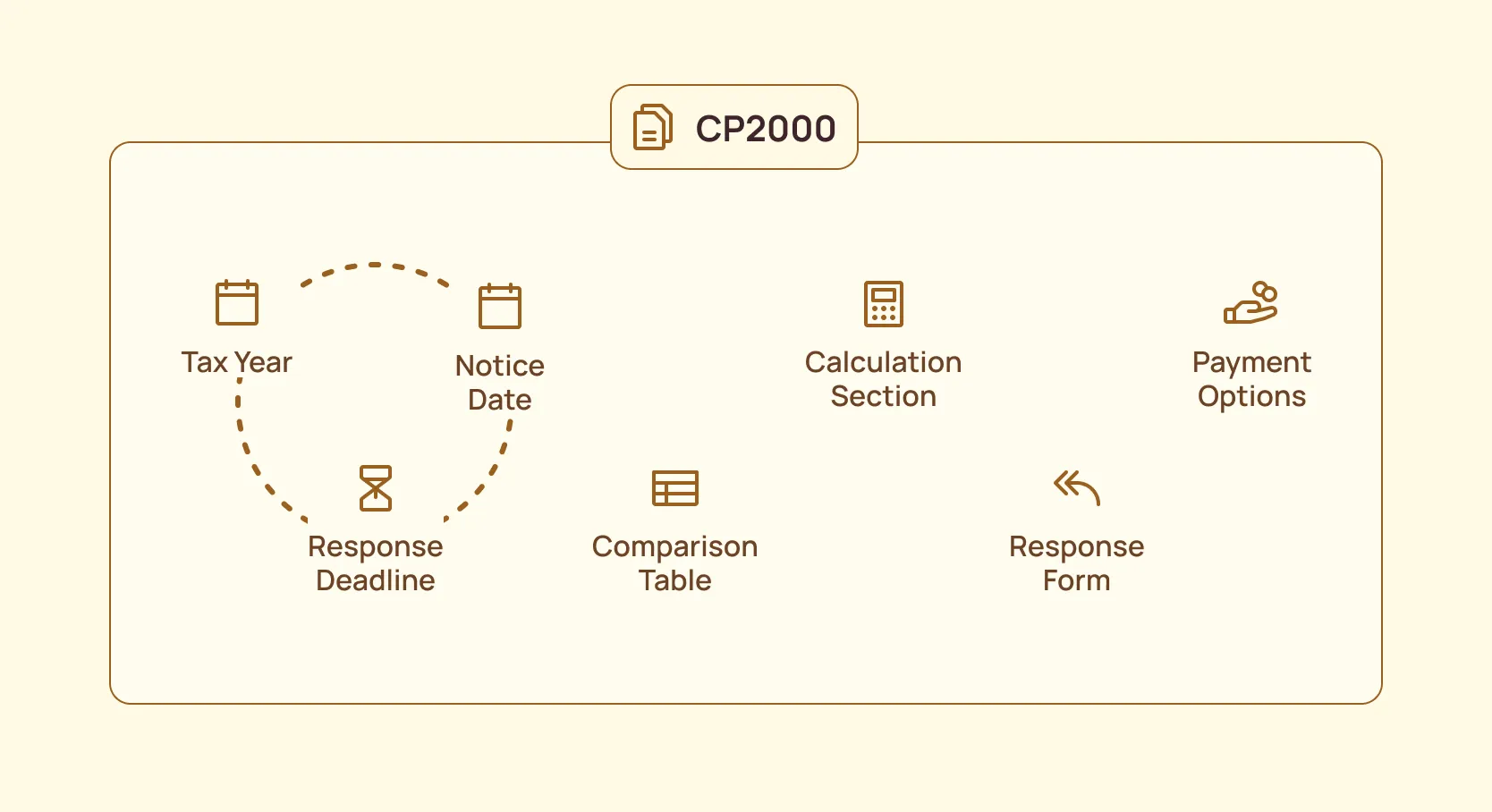
The CP2000 is a multi-page document. Reading all of it carefully before responding is essential because the response options and documentation requirements depend entirely on the specific discrepancy the IRS identified.
The first page contains the tax year in question, the notice date, the response deadline, and a summary of the proposed changes. The response deadline is the most important piece of information on the entire document. Note it immediately and set a calendar reminder.
The comparison table shows, side by side, what was reported on your return and what the IRS received from third parties. Each line represents a specific information return or income type, identified by the payer's name and TIN.
The calculation section shows how the IRS arrived at the proposed tax adjustment, including any interest calculated from the original due date of the return to 30 days from the notice date.
The response form is included in the notice and must be returned with your response. The response form has checkboxes for agreeing, disagreeing, or partially agreeing, a space for explanation, and a signature section. Unsigned responses will not be processed.
The notice also includes a list of payment options if you agree and owe additional tax.
The 30 day deadline and what it actually means
The IRS expects a response within 30 days of the date printed on the CP2000 notice. For taxpayers who live outside the United States, the window is 60 days from the notice date.
This is the notice date, not the date you received the letter. Because mail delivery can take one to two weeks, your actual response window may be closer to 20 to 25 days from the day you open it. If the notice was forwarded, delayed, or went to an old address, your available time is reduced further.
The 30-day response window is not a hard legal deadline in the same sense as the 90-day Tax Court petition window on a Statutory Notice of Deficiency. If you need more time, you can call the phone number printed at the top of the CP2000 and request a 30-day extension. The IRS will generally grant this extension, especially if you explain that you need additional time to gather documentation. Get the agent's name and the extension confirmation in writing if possible.
The clock for interest accrual runs separately. Interest on any proposed additional tax is calculated from the original due date of the tax return (not the CP2000 notice date) at the federal short-term rate plus three percentage points. Requesting more time does not stop interest from accruing on any amount that is ultimately owed. However, if the proposed amount is wrong and you dispute it successfully, the interest calculation is adjusted accordingly.
Your three response options
After reviewing the notice and comparing it against your records, you have three choices. Each requires a different action and a different supporting document package.
Option 1: You agree with the proposed changes
If you review the comparison table and confirm that the IRS is right, meaning the income or credit discrepancy is accurate and you did not report it correctly, you can agree with the proposed changes.
To agree, complete and sign the response form, indicate agreement, and return it by the deadline using the IRS Document Upload Tool, fax, or mail. If you owe additional tax and can pay the full amount, include payment with your response or pay online through IRS Direct Pay or EFTPS.
If you agree but cannot pay the full amount, you can apply for an installment agreement at IRS.gov or by calling the number on the notice. Interest continues to accrue on the unpaid balance throughout the installment period, but the payment arrangement prevents the account from moving to collections while you are making payments.
If you agree and the change also affects other items on your return (deductions, credits, or other income not mentioned in the notice), the IRS recommends filing a Form 1040-X amended return alongside your CP2000 response. Write "CP2000" at the top of the Form 1040-X so the IRS can connect the two submissions. The CP2000 Response form and the Form 1040-X go to different IRS departments, so both must be submitted separately.
Option 2: You disagree with the proposed changes
If you believe the IRS's proposed changes are incorrect, you have the right to dispute them. This is the option that requires the most documentation preparation but is entirely appropriate when the discrepancy is the result of a reporting error, a duplicate 1099, income that was already correctly reported in a different location on the return, or income that does not belong to you.
To disagree, check the disagreement box on the response form and attach a written explanation of your position along with supporting documentation. The explanation should identify each specific proposed change you are disputing, explain why the proposed change is incorrect, and reference the specific documents you are attaching as evidence.
Supporting documentation commonly includes the original documents you used to prepare your return (such as a 1099 that shows a different amount from what the IRS received from the payer), bank statements showing the actual deposit amounts, a corrected 1099 if the payer filed an incorrect original, a written explanation of where the income was reported on your return (for format difference cases), or documentation showing the income belongs to a different person or entity.
Send copies of all supporting documents, not originals. The IRS will not return originals. Mark each document with the tax year and your Social Security Number or EIN so the IRS can match it to your account if pages become separated.
Option 3: You partially agree
You can agree with some proposed changes and disagree with others on the same response form. Indicate agreement on specific line items where you accept the IRS's position and disagreement with documentation on the lines you are disputing. This is the most common outcome when a CP2000 contains multiple discrepancies and some are accurate while others are not.
How to submit your response?
The IRS provides three submission methods for CP2000 responses.
The IRS Document Upload Tool is the recommended method as of 2026. It allows you to upload the response form and all supporting documents electronically through a secure web portal using the access code on your notice. You receive a confirmation that your submission was received. This method creates the fastest and cleanest audit trail.
Fax is the second option. The fax number is printed at the top of the CP2000 notice. Keep the fax confirmation page as proof of submission with a timestamp.
Mail is the third option. Use the return address on the response form or the envelope included with the notice. If you mail a response, use USPS Certified Mail with Return Receipt, or a permitted private delivery service such as FedEx Priority Overnight, so you have proof of delivery with a timestamp. Keep a complete copy of everything you submitted.
Do not send a response to the general IRS mailing address. The CP2000 notice is handled by the Automated Underreporter unit, which has its own processing address printed on the notice. A response sent to the wrong address may not reach the correct unit before your deadline passes.
What happens if you do not respond?
Ignoring a CP2000 notice is the most expensive mistake you can make with it. If the IRS does not receive a response by the deadline, it assumes the proposed changes are correct and moves to the next step in its collection process.
After a non-response, the IRS issues a CP3219A, the Statutory Notice of Deficiency, also called a 90-day letter. This document gives you 90 days from the date of issuance to petition the United States Tax Court to challenge the proposed assessment before it becomes final. If you do not petition Tax Court within those 90 days, the proposed tax is assessed automatically and the balance moves to IRS Collections.
Unlike the 30-day CP2000 response window, the 90-day Tax Court petition deadline is absolute. The IRS cannot extend it and the Tax Court cannot extend it. It is set by statute under Internal Revenue Code Section 6213. If you miss it, the assessment becomes final and the only remaining options for reducing the balance are limited administrative appeals and the collection due process procedures, which are slower, more expensive, and less likely to result in full abatement of the underlying tax.
Interest accrues from the original return due date and continues throughout the entire process. Penalties, including the accuracy-related penalty of 20% of the understatement of tax, may also be added to the assessed balance.
Common reasons CP2000 notices are wrong or partially wrong
Receiving a CP2000 notice does not mean the IRS is correct. A significant portion of CP2000 cases are resolved through a disagreement response because the underlying discrepancy is a reporting artifact rather than an actual omission.
A duplicate 1099 is one of the most frequent causes of incorrect CP2000 notices. A payer that filed both an original and a corrected 1099 in the same tax year may have both versions appear in the IRS's matching database, doubling the apparent income. The taxpayer correctly reported only the accurate amount, but the IRS database reflects both.
Income reported on a different schedule or line from where the 1099 appears is another common scenario. Gross 1099-K receipts that match Schedule C revenue but were entered on a different line create a document-matching discrepancy even though no income was omitted.
A 1099 issued for a tax-exempt transaction, such as a return of principal on an investment, a reimbursement, or a loan repayment, can trigger a CP2000 because the gross amount appears in the IRS's database but the taxable amount is zero or lower. The disagreement response needs to explain the non-taxable nature of the payment with supporting documentation.
A 1099 sent to the wrong taxpayer, where the payer used an incorrect Social Security Number or EIN, creates an apparent discrepancy on the wrong person's return. Documenting that the TIN on the 1099 does not match yours and requesting that the payer issue a corrected 1099 is the resolution path.
What this means for India-US Founders and Delaware C-Corps
A CP2000 notice for a Delaware C-Corp arrives when the IRS's document matching identifies a discrepancy between Form 1120 and the information returns filed against the company's EIN. The most common triggers for a startup C-Corp are 1099-NEC forms from clients that do not match the revenue reported on Form 1120, Form 1099-K from payment processors where gross transaction volume exceeds reported revenue, and Schedule K-1 income flowing from partnerships or other pass-through entities in which the company holds an interest.
For Indian founders who file personal Form 1040-NR returns as non-resident aliens, CP2000 notices can also arrive at the individual level if there is a discrepancy between income reported on the personal return and 1099s or W-2s issued under the individual's ITIN or SSN. The response process and timeline are the same for Form 1040-NR filers as for domestic filers, with the 60-day response window applying to taxpayers who live outside the United States.
One practical issue for India-based founders is the mail delay. A CP2000 notice sent to a US address that is then forwarded internationally may arrive weeks after the notice date, significantly compressing the actual response window. Using a virtual mailbox with automated notification and digital scanning as your IRS correspondence address ensures you receive the notice as close to real-time as possible and know immediately when the clock has started.
Receiving an IRS CP2000 notice, gathering the right documentation, drafting a clear disagreement response, and submitting everything by the deadline is the kind of IRS compliance work that requires careful attention to timing and detail. Book a demo with Inkle to work through your notice with a cross-border tax professional who handles IRS correspondence for India-US startups and can help you respond correctly the first time.
Frequently Asked Questions
Is a CP2000 notice the same as a tax audit?
No. A CP2000 is a proposed adjustment generated by the IRS's Automated Underreporter program through automated document matching, not a formal examination of your return. It does not involve an IRS agent reviewing your records or requesting information about your expenses or deductions. Most CP2000 cases are resolved entirely through the mail or through the IRS Document Upload Tool without any in-person interaction. However, if you do not respond or the disagreement is not resolved administratively, the case can escalate to a formal examination with the same potential tax and penalty consequences.
How long do you have to respond to a CP2000 notice?
The standard response window is 30 days from the date printed on the notice, not the date you received it. For taxpayers living outside the United States, the window is 60 days. Because mail delivery can take one to two weeks, your actual available time after receiving the notice may be significantly shorter than 30 days. If you need more time, call the phone number on the notice immediately to request a 30-day extension. Keep a record of the call, including the date and the name of the IRS representative. Interest continues to accrue on any proposed tax owed regardless of whether an extension is granted.
What happens if you ignore a CP2000 notice?
If you do not respond by the deadline, the IRS assumes the proposed changes are correct and issues a CP3219A, the Statutory Notice of Deficiency, giving you 90 days to petition the US Tax Court. If you do not petition Tax Court within those 90 days, the proposed tax is assessed automatically, penalties and interest are added, and the balance moves to IRS Collections. The 90-day Tax Court petition deadline is absolute and cannot be extended by the IRS or the court. At that stage, the only remaining options are limited administrative appeals or collection due process procedures, which are significantly more difficult and expensive than responding to the original CP2000.
Can a CP2000 notice be wrong?
Yes, a significant portion of CP2000 notices reflect reporting format differences rather than actual income omissions. Common reasons a CP2000 may be inaccurate include a payer filing both an original and a corrected 1099 creating a duplicate in the IRS database, income correctly reported on a different schedule or line from where the 1099 maps in the IRS's matching system, a 1099 issued for a non-taxable transaction such as a loan repayment, or a 1099 sent to the wrong taxpayer because the payer used an incorrect TIN. In these cases, the correct response is to dispute the proposed change with documentation, not to accept the proposed additional tax.
.jpg)