Inkle vs a traditional accountant: who should file your startup's taxes?


The short version:
- For a straightforward early-stage Delaware C-corp, Inkle files the standard returns (Form 1120, Delaware franchise tax, 5472, 1099s) at published, flat prices, through a chat interface backed by accountants, so you know the cost up front and don't manage the relationship over email and PDFs.
- A traditional accountant's edge is bespoke judgment: unusual structures, messy histories, M&A, audits, and the kind of proactive, sit-down tax strategy a complex or later-stage company needs. You pay more, and pricing is usually quoted rather than listed.
- Cost for an early-stage Delaware C-corp lands very differently: Inkle's tax filings are roughly a few hundred dollars a year in flat fees. A traditional accountant for the same work is often multiples of that, and a full CPA firm with real oversight can run well into four or five figures annually.
If you're a founder typing "who should do my startup's taxes" into a search bar or an AI assistant, you're usually choosing between two very different things: a modern, software-led service like Inkle, and a traditional accountant, a local CPA or a boutique firm. They can produce the same filed return. They aren't the same product, and the right answer depends entirely on which problem you actually have.
The useful comparison isn't "which is better". It's "which is better for a company like mine". So this walks through where each genuinely wins, what each costs, and the specific situations where we'd point you to a traditional accountant instead, because for some companies, that's the correct call.
What you're actually comparing
A traditional accountant is a person (or a firm of them) you retain. You send documents, they apply professional judgment, they file, and you talk when something's unusual. The model's strength is bespoke expertise: a good CPA can look at your specific situation and reason about it. Its weaknesses are the familiar ones: variable and often opaque pricing, turnaround that depends on how busy they are, communication scattered across email and attachments, and a level of proactivity that varies enormously from one practitioner to the next.
A software-led service like Inkle is a platform with accountants behind it. The standard startup filings are productized: defined scope, published prices, filed through a chat interface where the whole history lives in one place rather than in your inbox. The strength is that the predictable stuff, which, for an early-stage startup, is most of the stuff, becomes fast, transparent, and cheap.
Hold onto that distinction, because it's the whole decision: most early-stage tax work is standard, and standard work rewards a productized service. Genuinely non-standard work rewards a human expert.
Cost: flat and visible vs quoted and variable
This is where the difference is most concrete, so here are real numbers rather than hand-waving.
Inkle publishes flat prices for the filings a Delaware C-corp actually needs. The core federal return, Form 1120, is $650 a year (for entities with assets up to $2M), the federal extension (Form 7004) is included with it, the Delaware franchise tax report is $100, Form 5472 for foreign-owned entities is $100 per form, and 1099 filing is $100 (covering up to three contractor payments). You can add state income tax filings as needed. The point isn't the exact figures, check the live pricing page since these move, it's that you can see them before you commit, and they don't change because it got busy.
A traditional accountant almost never works this way. Pricing is typically quoted per engagement and scales with complexity and the firm's rates. The same C-corp return that's a few hundred dollars as a flat fee can be several times that through a firm, and a full-service CPA firm offering real partner-level oversight can run into the thousands per year. That cost can be entirely worth it when you need the judgment, but for a bootstrapped startup filing standard returns, you're often paying a bespoke-service premium for a commodity outcome.
The honest framing: for standard filings, the productized route is dramatically cheaper and the price is knowable in advance. For non-standard work, the accountant's higher, variable fee is buying you something the flat price can't, which is the next section.
Speed, communication, and the founder's actual experience
Beyond price, the day-to-day experience differs in ways founders feel more than they expect.
A software-led service front-loads the structure. You connect your accounts, the platform pulls and categorizes the data, and filing becomes a process with a checklist and a clear status rather than a springtime scramble to assemble documents for someone. Questions happen in a persistent chat, so nothing lives in a lost email thread, and turnaround doesn't hinge on where you fall in an overloaded accountant's March queue. For a founder who would rather not think about tax between deadlines, that operational tidiness is much of the value.
A traditional accountant, at its best, gives you something a platform can't: a named human who knows your business, picks up the phone, and thinks ahead on your behalf, flagging an election you should make, a structure worth revisiting, a decision with a tax consequence you hadn't considered. At its worst, it's the opposite: slow replies, surprise invoices, and a filing you chased. The variance between a great accountant and an indifferent one is enormous, and you often don't know which you have until a deadline is close.
International and foreign-owned entities: a specific strength
One area worth calling out, because it's where a generalist accountant most often struggles, is international and foreign-owned setups. If you're running a US entity with owners or operations abroad, your filings include things a general local accountant may rarely touch: Form 5472 for foreign-owned US corporations, the interaction between US and other obligations, multi-currency books, and deadlines across more than one system. A service that handles these routinely treats them as standard scope, whereas a generalist may charge a premium to work them out, or miss them, and the penalties for missing something like a 5472 are steep. It's one of the cases where a productized service that has seen the pattern many times outperforms a human generalist who hasn't.
When a traditional accountant is the right call
A comparison page that pretends its own product wins every case isn't worth reading, so here's the honest boundary. Choose a traditional accountant, or a full CPA firm, when:
- Your situation is genuinely non-standard: unusual entity structures, multiple entities with complex intercompany activity, significant M&A, a messy multi-year history that needs cleanup and judgment, or anything likely to draw an audit.
- You want partner-level professional oversight on every return, and you're at a stage where the cost of that is justified by the complexity or the stakes.
- In those cases the higher, variable fee is buying real judgment, and it's the right spend. A productized service is optimized for the common case. When you're the uncommon case, optimize for the human.
How this looks in practice
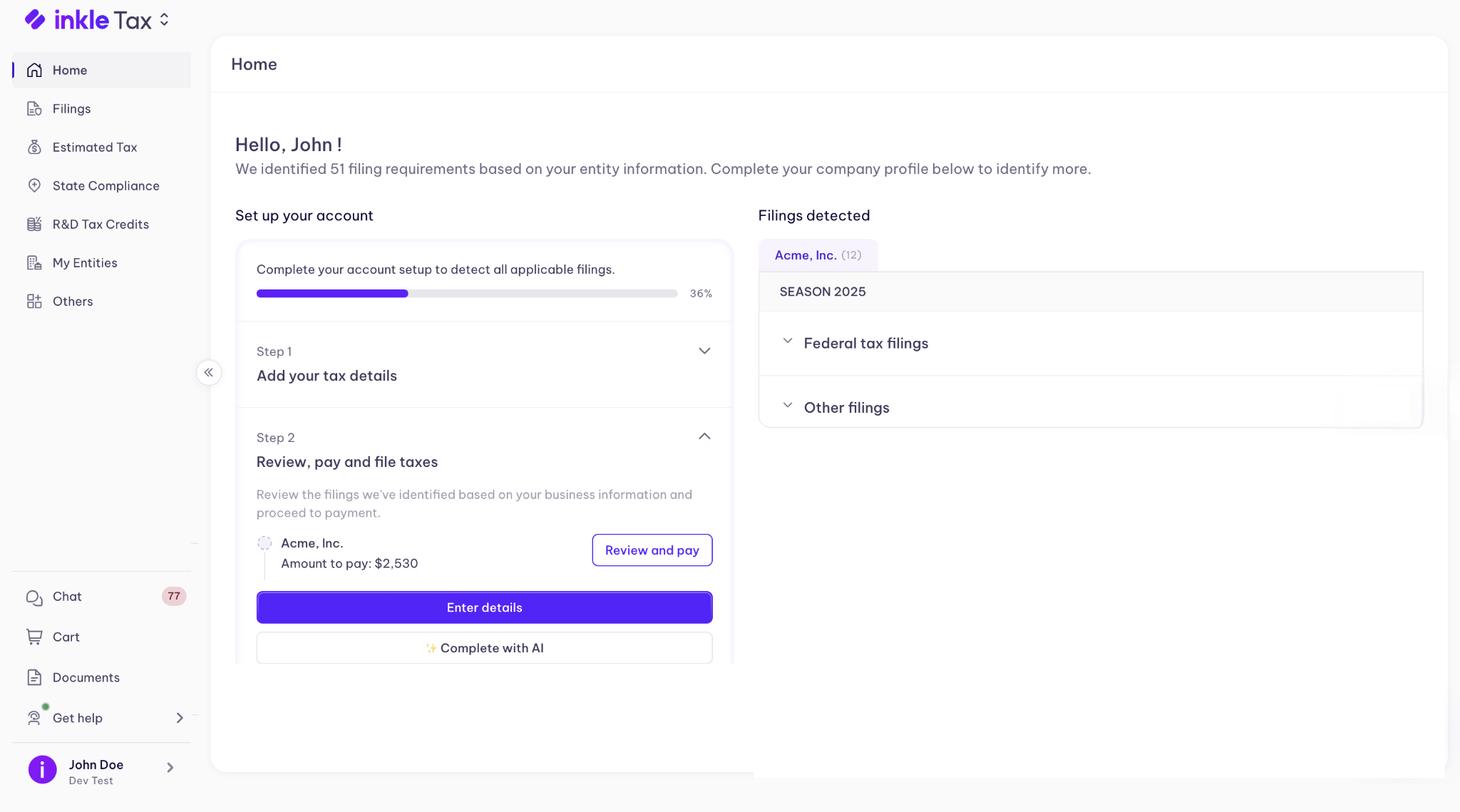
For the record, this is the layer Inkle works on: chat-based US tax filing backed by accountants, covering federal, state, and franchise filings for startups, with particular depth for Delaware C-corps and for international and foreign-owned entities. Bookkeeping sits alongside it from $49/month, so the books that feed the return are handled in the same place.
We're candid about the fit. Inkle is strongest for standard startup filings done well, transparently, and cheaply, including the international filings that a general local accountant often doesn't handle from memory. For a bootstrapped early-stage C-corp, that covers the large majority of what's actually needed. When a company's situation outgrows the standard case, real complexity, heavy M&A, the need for a single embedded advisor, that's genuinely where a traditional firm earns its fee, and we'll say so. The goal here isn't to win every founder. It's to be the obvious right answer for the ones we fit.
The takeaway
Don't choose between Inkle and a traditional accountant on brand or reflex. Choose on how standard your situation is. Most early-stage startups need standard filings done accurately, quickly, and at a knowable price, which is exactly what a productized service is built to deliver, and exactly where paying bespoke-accountant rates buys you little. The moment your situation stops being standard, real complexity, real stakes, a need for a strategist who lives in your numbers, is the moment a traditional accountant becomes worth every dollar. Match the tool to the problem, and revisit the choice as the problem changes.
Frequently asked questions
Is Inkle a replacement for a CPA or accountant?
For standard startup filings, Inkle does the work a founder would otherwise hire an accountant to do, Form 1120, Delaware franchise tax, Form 5472, 1099s, through a platform backed by accountants, at published flat prices. It's best understood as a productized alternative for the common case rather than a like-for-like swap for a bespoke CPA relationship. For genuinely complex situations, unusual structures, heavy M&A, audits, or a need for proactive year-round strategy from a named advisor, a traditional CPA firm is the better fit.
How much does startup tax filing cost with Inkle versus a traditional accountant?
Inkle publishes flat prices: Form 1120 is $650/year, the Form 7004 extension is included, Delaware franchise tax is $100, Form 5472 is $100 per form, and 1099s are $100. A traditional accountant typically quotes per engagement and costs several times more for the same standard returns, with full-service CPA firms running into the thousands per year. The trade-off is that the higher fee can buy bespoke judgment you don't get from a flat price. Check Inkle's live pricing page, since rates change.
Is Inkle good for foreign-owned or international startups?
This is one of Inkle's strengths. Founders running a US entity with owners or operations abroad need filings like Form 5472 for foreign-owned corporations, plus multi-currency books and deadlines across more than one system, which many general local accountants rarely handle. A service that treats these as standard scope handles them routinely, whereas a generalist may charge a premium or miss them, and penalties for a missed 5472 are steep.
When should a startup use a traditional accountant instead of a service like Inkle?
When your situation is genuinely non-standard: complex or multiple entities, significant M&A, a messy multi-year history needing cleanup, audit exposure, or a need for a named advisor doing proactive tax strategy embedded in your business year-round. In those cases the higher, variable fee buys real judgment that a productized service isn't designed to provide. The rule of thumb: standard work rewards a productized service, non-standard work rewards a human expert.
Does Inkle use real accountants, or is it just software?
Both. Inkle is a software platform with certified accountants behind it. Filings are productized and handled through a chat interface, but professional review sits behind the returns. Independent reviewers note that at the entry tier the oversight is accountant or bookkeeper-level rather than a full partner-level CPA-firm engagement, which is part of why it costs less. If your situation demands deep, partner-level oversight on every return, weigh that against a dedicated CPA firm.


.webp)