How to dissolve a startup that still has employees?



Dissolving a startup is complicated enough when it is just the entity. When employees are in the picture, the complexity increases across four separate dimensions that founders have not planned for: federal and state notice requirements, final compensation obligations, healthcare continuation rights, and a stack of payroll filings that outlast the last day of operations.
Missing any one of these obligations can expose the company to significant legal and financial liability, and in some jurisdictions may also create personal liability for company officers or other responsible individuals. Final paycheck violations in certain states can result in waiting-time penalties and officer liability. COBRA failures can expose the plan sponsor to claims, while WARN Act violations may require employers to provide back pay and benefits for the applicable notice period.
This article covers every employee-related obligation a startup must handle when winding down, in the order those obligations arise. For the general corporate dissolution process including board resolutions, shareholder approvals, creditor notices, and state filings, the complete step-by-step guide is in Inkle's Delaware Corporation Dissolution Guide.
Step 1: Determine whether the Federal WARN Act applies
The Worker Adjustment and Retraining Notification Act is the first thing to check when a startup with employees begins planning a shutdown. The WARN Act requires employers with 100 or more full-time employees to provide at least 60 calendar days advance written notice before a plant closing or mass layoff. The law is codified at 29 U.S.C. Section 2101 and the sections that follow it.
The 100-employee threshold excludes part-time employees, meaning those who average fewer than 20 hours per week or who have been employed for fewer than six of the preceding 12 months. Part-time employees are not counted toward the 100-employee threshold, but they are entitled to receive notice if a covered event occurs. If your startup has 100 or more qualifying full-time employees, or 100 or more employees who work a combined total of at least 4,000 hours per week excluding overtime, WARN Act coverage applies.
A WARN notice is triggered by a plant closing affecting 50 or more employees at a single site of employment, or a mass layoff affecting at least 50 employees who constitute 33% or more of the workforce, or 500 or more employees regardless of the percentage, during any 30-day period. A covered event also occurs when employees will be laid off for more than six months, or will have their regular hours reduced by more than half during each month of a six-month period.
When WARN applies, notices must be sent to four parties simultaneously: the affected employees or their union representatives, the state dislocated worker unit in each state where affected employees work, and the chief elected official of the local government where the closing occurs.
An employer that fails to provide the required WARN notice may be liable for back pay and benefits for affected employees for the period of the violation, up to a maximum of 60 days, subject to the statute and applicable court interpretations. If notice was provided but fell short of the full 60 days, the employer is liable only for the shortfall period. An employer who provides 30 days of notice instead of 60 owes 30 days of back pay per affected employee.
Three exceptions allow shorter notice: the faltering company exception, which applies when the company was actively seeking capital or business that would have allowed it to avoid or postpone the shutdown and reasonably believed that giving notice would have precluded it from obtaining that capital; unforeseeable business circumstances, which cover a sudden, dramatic, and unexpected condition outside the employer's control; and natural disasters. These exceptions are narrow and require documentation. They do not eliminate the obligation entirely. Even when a WARN Act exception applies, the employer must still provide as much notice as is practicable, along with a brief statement of the reason for reducing the notice period.
Step 2: Check state Mini-WARN acts for lower thresholds
Several states have enacted their own notice laws that apply to smaller employers than the federal WARN Act threshold of 100 employees. These state laws can significantly expand your notice obligations even if the federal WARN Act does not apply to your startup. For a startup with remote employees spread across multiple states, each state's mini-WARN law applies independently based on the location of the affected employees.
California (Cal-WARN) requires 60 days notice for employers that have 75 or more employees when a covered establishment closes or 50 or more employees are laid off within a 30-day period. California was the site of significant Cal-WARN enforcement and litigation during the tech layoffs of 2022 and 2023, and its statute has fewer exceptions than the federal law.
New York (NY WARN) requires 90 days notice, which is longer than the federal requirement, for employers with 50 or more employees. New York's law is triggered by a mass layoff affecting 25 or more employees who make up at least 33% of the workforce, or 250 or more employees regardless of percentage.
New Jersey's WARN Act includes unique notice and severance requirements that differ from the federal WARN Act, including mandatory severance in many covered layoffs. Because the law has undergone significant amendments in recent years, employers should review the current requirements carefully before proceeding with a workforce reduction.
Illinois (IL-WARN) requires 60 days notice for employers with 75 or more full-time employees when a plant closing or mass layoff affects 25 or more full-time employees who constitute at least 33% of the workforce, or 250 or more employees.
A startup with 40 employees in California and 40 in Texas does not trigger the federal WARN Act threshold of 100, but the California count alone can trigger Cal-WARN once the layoff size and establishment tests are met. Checking every state where employees work, not just the state of incorporation, is essential.
Step 3: Issue WARN notices if required
If WARN or a state equivalent applies, issue the notices before announcing the shutdown publicly or notifying only some employees. Notice must go to each affected employee individually in writing, in addition to the state and local government notifications.
The notice must include the name and address of the employment site where the closing or layoff will occur, a statement of whether the action is permanent or temporary, the expected date of the first separation and the anticipated schedule of subsequent separations, the job titles of affected positions and the number of employees in each, and the name and contact information of a company official who can provide further information.
Timing is measured from service of the notice. As a general matter, an employer cannot order a plant closing or mass layoff until the end of the 60-day period after the employer serves written notice. This means the 60-day clock runs from the date notice is actually served on employees and government units, not from the date the company decides internally to shut down or announces its plans externally.
If the company cannot afford to continue operations for the full 60 days after notice is served, the WARN Act exception provisions may reduce the required notice period, but the exception must be specifically documented and the reason stated in the notice itself. Simply running out of money is not automatically an unforeseeable business circumstance, and courts have scrutinized this defense closely.
Step 4: Pay final wages according to each state's timing law
Final paycheck timing is governed entirely by state law, and the rules differ significantly across states. The controlling law is the state where the employee works, not the state where the company is headquartered or incorporated. A payroll team in Texas processing a termination for a California-based employee follows California law.
The federal Fair Labor Standards Act sets only a baseline: all earned wages are due by the next regularly scheduled payday for the final pay period. The FLSA does not require immediate payment, does not mandate PTO payout, and does not differentiate between terminations and resignations. State law fills those gaps, and the variation is significant.
Some states require employers to provide final wages immediately or within a very short statutory period following an involuntary termination. These include California, Colorado, Massachusetts, Missouri, Montana, and Utah, although the exact timing requirements vary by state.
California requires immediate payment of all earned wages at the time of an involuntary termination, at the place of termination. These rules are written into California Labor Code Section 201 for terminations and Section 202 for resignations. An employer that delays the final paycheck can incur waiting-time penalties equal to the employee's daily rate of pay for each day the payment is late, up to a maximum of 30 days.
Massachusetts requires payment of all earned wages on the day an employee is involuntarily discharged.
Colorado requires final wages immediately upon termination if the employer's accounting unit is available, or within 24 hours of the start of the next regular workday if it is not.
Most other states require final wages by the next regularly scheduled payday. Four states, Alabama, Florida, Georgia, and Mississippi, have no state-specific final paycheck statute, so the FLSA baseline of the next regular payday applies.
Accrued and unused vacation pay is treated separately from wages and also varies by state. Several states—including California, Colorado, Montana, Nebraska, and North Dakota—generally treat accrued vacation as earned wages that must be paid out upon termination, regardless of the employer's policy. In many other states, whether unused vacation or PTO must be paid depends on state law and the employer's written policy.
In California, earned but unused vacation must be included in the final paycheck, though accrued sick leave generally does not have to be paid out. States including Florida, Georgia, and Texas allow employers to set policies under which unused PTO is forfeited at termination, provided the policy is clearly documented and communicated in advance.
Step 5: Handle COBRA notices within the required timeframe
When a business closes and terminates its group health plan, the Consolidated Omnibus Budget Reconciliation Act creates specific notification obligations for any employer that maintained a group health plan and had 20 or more employees on more than half of its typical business days in the prior calendar year.
The termination of employment is a qualifying event that gives covered employees and their covered dependents the right to elect continuation coverage. The plan administrator must furnish a COBRA election notice to each qualified beneficiary within 14 days after receiving notice of the qualifying event. When the employer is also the plan administrator, which is common for startups, the employer generally has up to 44 days from the qualifying event to provide the election notice, because the separate employer-to-administrator notification step and the administrator-to-beneficiary step are combined.
The COBRA election notice must identify the plan, describe the qualifying event, identify the qualified beneficiaries, explain the coverage available and the deadline to elect, state the premium amount and due dates, and explain the consequences of failing to elect.
Qualified beneficiaries have 60 days from the later of the date of the notice or the date coverage would be lost to elect continuation coverage. If elected, coverage generally continues for up to 18 months, and the individual pays the full premium (the previous employee and employer shares combined) plus a permitted 2% administrative charge.
There is an important limitation specific to business closures. COBRA continuation coverage requires that the employer continue to maintain a group health plan. If the startup terminates its group health plan entirely and no successor plan exists within a controlled group, there may be no plan under which to continue coverage, which can cut off or limit COBRA rights. Because this outcome depends on the plan terms, the carrier's rules, and whether any related entity maintains a plan, consulting counsel familiar with ERISA and COBRA before the health plan is terminated is strongly advisable.
Step 6: File final payroll tax returns
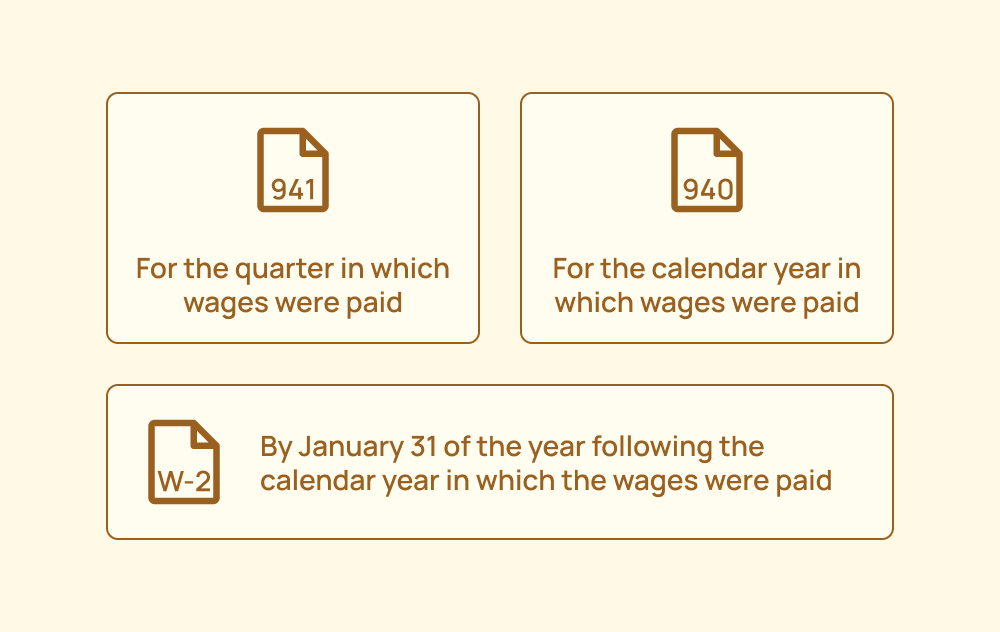
Several payroll tax filings must be completed after the last payroll is processed. These filings are required regardless of how small the startup's payroll was, and the penalties are assessed per return, not per dollar of tax owed.
Form 941, Employer's Quarterly Federal Tax Return: File a final Form 941 for the last quarter in which wages were paid. Check the box indicating this is a final return, and attach a statement identifying the person who will keep the payroll records after the business closes and the address where those records will be kept.
Form 940, Employer's Annual Federal Unemployment Tax Return: File a final Form 940 for the calendar year in which the last wages were paid. Check box d in the Type of Return section to mark it as a final filing. If the calendar year has not ended when the business closes, file the final Form 940 once the last wages have been paid rather than waiting until the following January.
Form W-2, Wage and Tax Statement: Furnish each employee with a Form W-2 by January 31 of the year following the calendar year in which wages were paid. If the business closes before year-end and no further wages will be paid, employers may furnish Forms W-2 earlier after processing the final payroll. For a startup that closes mid-year, W-2s may be furnished earlier once all wages for the year have been paid. File Form W-3, Transmittal of Wage and Tax Statements, to send Copy A of all W-2s to the Social Security Administration.
State payroll tax returns and account closure: Every state in which you had employees has its own final payroll return requirements. Most mirror the federal sequence but have their own forms, deadlines, and final-return indicators. Closing each state's unemployment insurance account and state withholding account requires a separate notification to that state's tax or labor agency. Leaving these accounts open can generate ongoing filing obligations and estimated assessments even after the entity is dissolved.
Step 7: Notify benefit plan administrators and close benefit accounts
Beyond healthcare, any other employee benefit plans maintained by the startup must be formally terminated or transitioned.
401(k) or other retirement plans: A qualified retirement plan must be formally terminated by a resolution of the company's board of directors, which establishes a termination date and fully vests all affected participants as required on plan termination. Participants must be notified and given the opportunity to roll over their account balances to an IRA or a new employer's plan. A final Form 5500 must be filed for the plan's final year, and the plan is not considered fully terminated until all assets have been distributed.
Health FSA and dependent care FSA accounts: The plan document governs what happens to balances at termination. Employees should be notified of the last date to incur eligible expenses and the deadline for the plan's run-out period to submit claims.
Life and disability coverage: Group life insurance and long-term disability policies often include conversion rights that allow employees to convert to individual policies within a set window after the group coverage ends. Those conversion rights and deadlines should be communicated to affected employees.
Step 8: Handle equity and options for departing employees
If employees hold unvested stock options, restricted stock units, or other equity awards, the company's equity incentive plan and the individual grant agreements govern what happens to those awards at dissolution.
For most startup equity plans, unvested options are forfeited on the termination of employment unless the plan or a board action provides for acceleration. A dissolution may be treated as a change-of-control or corporate-transaction event under the plan, which can trigger acceleration provisions, or as an ordinary termination, depending entirely on the plan's language.
Employees with vested but unexercised options typically face a post-termination exercise window, often 90 days from the last day of employment, after which the options expire. In a dissolution with no liquidity event and no secondary market, employees may have no practical way to realize value from vested options before they expire, and exercising may require paying the strike price and potential tax with no ability to sell.
The equity plan administrator, whether that is company counsel or a cap table platform, should communicate the specific treatment of each employee's awards at the time the dissolution is announced rather than after employment has ended, so employees can make informed decisions within the applicable deadlines.
Documentation and record retention after closure
Employment records do not disappear at dissolution. The IRS requires employment tax records to be kept for at least four years after the tax becomes due or is paid, whichever is later. Form I-9 records for each employee must be retained for three years after the date of hire or one year after employment ends, whichever is later.
WARN Act documentation, where applicable, should be retained as evidence of compliance, and state labor records such as timesheets, final paycheck calculations, and PTO payout records should be kept for a minimum of three to four years, longer in states like California where wage claims carry extended statutes of limitations.
Former employees can bring wage claims, benefits claims, and discrimination claims for years after a company closes. Maintaining organized records in a secure digital archive with a designated custodian allows the company's officers or successors to respond to any claim without paying to reconstruct records that were never properly preserved.
Coordinating final payroll filings, WARN Act notices, COBRA compliance, state payroll account closures, and employee equity communications across a startup shutdown requires attention to timing and jurisdiction that is easy to miss under the pressure of winding down. Book a demo with Inkle to handle the employer-side obligations of your dissolution correctly and avoid personal liability exposure in the process.
Frequently Asked Questions
Does the WARN Act apply to startups with fewer than 100 employees?
The federal WARN Act applies to employers with 100 or more full-time employees, so a startup below that count is not covered federally. However, several states have mini-WARN laws with lower thresholds. California applies at 75 employees, New York at 50 employees with 90 days notice, and Massachusetts and New Jersey at their own thresholds. A startup with 60 employees in California can trigger Cal-WARN even though it would not trigger the federal law, so check every state where your employees work.
When must COBRA notices be sent when closing a startup?
The plan administrator must send the COBRA election notice within 14 days of receiving notice of the qualifying event. When the employer is also the plan administrator, which is common for startups, the combined deadline is generally up to 44 days from the qualifying event. Employees then have 60 days to elect coverage. Employers with fewer than 20 employees in the prior year are not subject to federal COBRA but may face state continuation coverage rules.
Which states require immediate final paycheck payment when closing a business?
California, Massachusetts, Colorado, Missouri, Montana, and Utah require same-day or near-immediate final pay for involuntary terminations such as layoffs. California requires payment immediately at the place of termination and imposes waiting-time penalties of up to 30 days of pay for delays. Most other states require final wages by the next regular payday. PTO payout is separate: only California, Colorado, Montana, Nebraska, and North Dakota require accrued vacation to be paid out regardless of policy.
What IRS forms must be filed for employees when a startup closes?
File a final Form 941 for the last quarter wages were paid, with the final-return box checked and a statement naming who will keep the payroll records. File a final Form 940 for the year of closure. Furnish final Form W-2s to employees by the due date of the last Form 941 or January 31, whichever is earlier, and file Form W-3 to transmit them to the Social Security Administration. State payroll returns and account closures follow separately in each state where employees worked.
.jpg)

.webp)
.webp)
.webp)