Does the DExit Trend Actually Affect Your Startup?



The headlines in 2026 have been hard to ignore.
Dell Technologies, a company incorporated in Delaware since 1988 with a market cap of $137 billion, announced in May 2026 that its entire board voted to move its legal home to Texas. The shareholder vote is scheduled for June 25, 2026, with approval widely expected given that Michael Dell and Silver Lake together control more than 90% of the voting power.
ExxonMobil, incorporated in New Jersey since 1882, had its board recommend the same move to Texas in March 2026, and shareholders approved it on May 27, 2026, with 71.3% support. Coinbase completed its reincorporation from Delaware to Texas in December 2025. Before all of them came Tesla, SpaceX, Dropbox, TripAdvisor, Andreessen Horowitz, and dozens of other public companies that either left Delaware or filed proposals to do so.
The data behind the trend is real and accelerating. Between January 2024 and March 2026, approximately 49 Delaware-incorporated public companies submitted redomestication proposals to their stockholders. In 2025 alone, 26 such proposals were filed, a 70% increase over the prior year. At the IPO level, Delaware's share of new public offerings dropped from 81.4% in 2024 to approximately 62% in 2025, with Nevada capturing around 17% and Texas picking up about 4%.
If you are a founder building a venture-backed startup, especially one incorporating in the US from India, you should read every one of these headlines and then do exactly nothing about them.
Here is why.
What is actually driving DExit?
To understand why the DExit trend is irrelevant to your startup, you first need to understand who is actually leaving Delaware and what is motivating them.
The movement traces back to a single legal event. In January 2024, the Delaware Court of Chancery invalidated Elon Musk's $56 billion Tesla compensation package, ruling that the approval process was unfair to shareholders. Attorney fees in that case alone exceeded $345 million. Around the same time, TripAdvisor's controlling shareholders fought a prolonged legal battle in Delaware courts over their attempt to restructure the company.
These rulings sent a clear signal to a very specific type of corporate leader: founders and controlling shareholders who own large stakes in mature public companies. For them, Delaware's Court of Chancery, historically praised for its sophistication, had started to feel like a liability. A court that would invalidate a CEO's pay package and require shareholder-protective processes in related-party transactions was not the court they wanted governing their company.
So they left. Or filed to.
The data point that the headlines consistently bury; 55% of all reincorporation proposals in 2025 involved companies with significant or controlling shareholders. This is not a broad corporate exodus. It is a small, specific class of controlled public companies, the Elon Musks, Michael Dells, and Bill Ackmans of the world, seeking more permissive governance environments where their compensation arrangements and related-party transactions face less judicial scrutiny.
The parallel pattern at Dell confirms this clearly. In its proxy filing, the company disclosed that because Michael Dell and Silver Lake together control more than 90% of the voting power, approval of the redomestication is essentially guaranteed regardless of how other shareholders vote.
Delaware fought back and won
The state did not sit quietly while companies announced plans to leave. In March 2025, Delaware lawmakers fast-tracked Senate Bill 21, the most sweeping overhaul of the Delaware General Corporation Law in over half a century. Governor Matt Meyer signed it on March 25, 2025, within weeks of its introduction.
SB 21 directly addressed the legal concerns that had triggered the DExit wave. It rewrote core provisions governing conflict-of-interest transactions and controlling shareholder deals, giving boards clearer safe harbors and substantially reducing the risk of protracted shareholder litigation. Critics argued it went too far in protecting insiders. Supporters said it restored the predictability that Delaware's reputation was built on.
Specifically, SB 21 amended two sections of the DGCL. Section 144 now provides explicit statutory safe harbors for transactions involving controlling stockholders, protecting boards and directors from equitable relief or damages when proper approval procedures are followed. Section 220, which previously gave shareholders broad rights to inspect corporate books and records including emails and communications, was narrowed to cover only formal corporate documents and board materials. Together these changes addressed the two biggest litigation tools that had been used against Delaware companies in the years leading up to DExit.
On February 27, 2026, the Delaware Supreme Court settled the debate unanimously. In Rutledge v. Clearway Energy Group LLC, the court upheld the constitutionality of SB 21's safe harbor provisions, confirming that the amendments do not strip the Court of Chancery of its equitable jurisdiction and can be applied retroactively.
The official formation data confirms this. Delaware recorded approximately 289,810 total business entity formations in 2024. In 2025, approximately 30% more Delaware corporations were formed than in 2024, far exceeding the prior trendline and making 2025 one of the best years in Delaware's history for new incorporations. This growth happened while national incorporation levels remained essentially flat. The state added roughly 100,000 net new entities in 2025, bringing the total active entities in Delaware to approximately 2.2 million.
To put that in perspective, nearly 1,400 corporations picked Delaware as their legal home every week throughout 2025.
The one number that puts the whole story in perspective
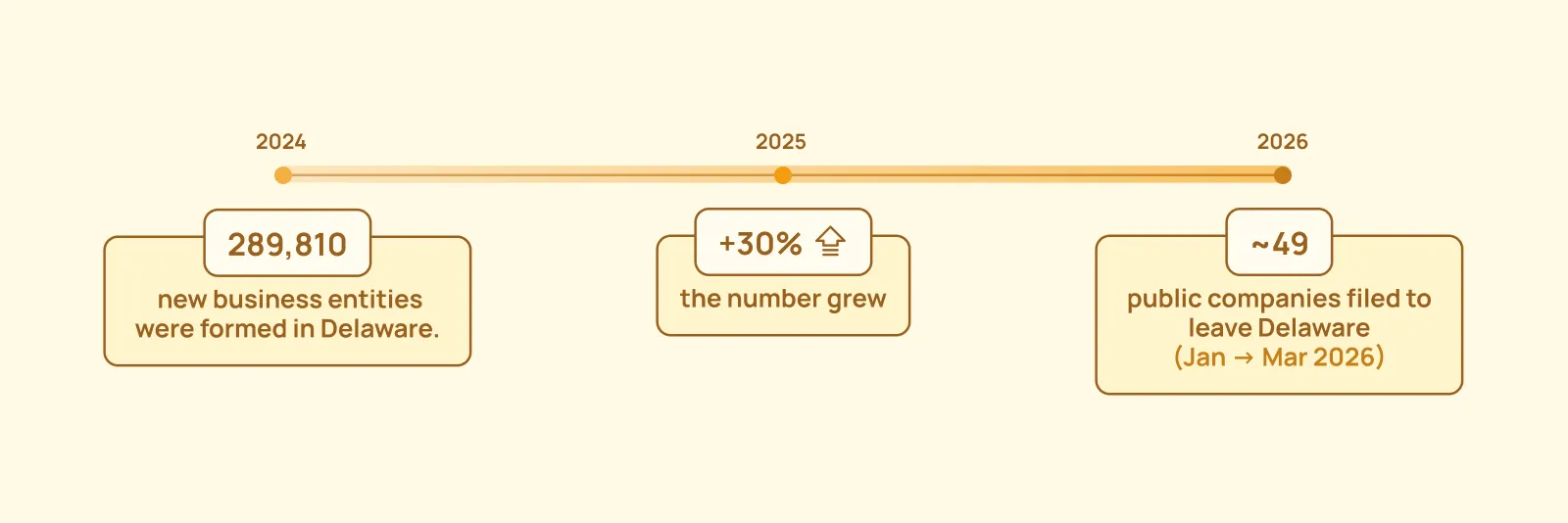
The DExit story is about fewer than 50 companies at the top of the corporate food chain making governance decisions that protect their controlling shareholders. The counter-story, the one that generates no headlines, is that hundreds of thousands of new entities, most of them private companies and startups, continued to choose Delaware as their home while the debate was playing out.
These are not naive founders following outdated advice. These are seed-stage and Series A companies whose lawyers, investors, and term sheets all point to the same answer.
Why does Delaware still make sense for your startup?
Your investors require it
This is not a preference. It is structural. VC term sheets, SAFEs, convertible notes, stock option plans, drag-along rights, and protective provisions are all written around Delaware corporate law. When a VC's legal team reviews your cap table, they are working from a body of case law they know cold. The venture financing stack has been standardized around Delaware for decades, and no change in the legal landscape of public company governance alters that.
If you tell a seed-stage VC you incorporated in Nevada or Texas, the conversation typically ends with: "Come back after you convert." That conversion will cost you several thousand to more than $10,000 in legal fees depending on your cap table complexity, plus filing fees in multiple states, investor consents, and weeks of distraction at a time when you should be building.
As of 2025, approximately 66.7% of all Fortune 500 companies and 81.4% of US-based IPOs remain incorporated in Delaware. Every major VC fund, law firm, and investment bank has standardized its documentation around Delaware corporate law. Switching states does not just create friction with your current investors. It creates friction with every future investor, acquirer, and legal counterparty you will ever work with.
The reasons companies are leaving do not apply to you
The public companies leaving Delaware are controlled by billionaire founders who resented having their compensation packages challenged in court. The legal environment that drove Tesla, Coinbase, and Dell out of Delaware requires a large market cap, a dual-class share structure, a history of related-party transactions, and activist shareholders with the resources to pursue derivative lawsuits.
A seed or Series A startup has none of these. The legal risk that these companies were managing is simply not present at your stage.
The franchise tax argument also collapses under scrutiny. One company leaving for Nevada cited savings of approximately $175,000 to $200,000 per year on Delaware franchise taxes. Coinbase noted it had previously paid approximately $250,000 annually. For your early-stage startup with a standard share structure, the Delaware franchise tax under the assumed par value capital method is typically a few hundred to a few thousand dollars per year. There is no financial case for leaving.
Delaware SB 21 addressed the core legal problem and survived
The governance unpredictability that spooked public company boards has been directly addressed and judicially validated. The Delaware Supreme Court upheld SB 21 unanimously in March 2026. For startups, the daily operational impact of SB 21 is minimal, but its passage and court validation matter because they demonstrate that Delaware has the legislative will, a functioning specialized judiciary, and the responsiveness to defend its position. Nevada and Texas are building their corporate legal frameworks largely from scratch. Delaware has over two centuries of corporate case law that cannot be replicated on a short timeline.
Why Texas specifically, and why it still does not matter for your startup
One detail the DExit headlines often skip: companies are not moving to Nevada and Texas randomly. Texas made deliberate legal changes to attract them.
In May 2025, Texas Governor Greg Abbott signed Senate Bill 29, creating a new threshold requiring ownership of at least 3% of a company's shares before a stockholder can bring a derivative lawsuit. This is far higher than Delaware's standard, and it directly protects founders and controlling shareholders from the kind of litigation that cost Elon Musk $345 million in legal fees. Texas also established a specialized Business Court in 2024, modeled loosely on Delaware's Court of Chancery, specifically to handle complex commercial disputes.
For a public company controlled by a billionaire founder who wants to reduce shareholder litigation exposure, this matters enormously. For your seed-stage startup where your only shareholders are your co-founders, a small angel round, and perhaps a pre-seed fund, a 3% derivative suit threshold is completely irrelevant. You have no activist shareholders. You have no related-party transactions being challenged in court. The entire legal architecture that Texas built to attract DExit companies addresses problems you will not have for a decade, if ever.
QSBS requires a C-Corp, and your Delaware structure is built for it
Under Section 1202 of the Internal Revenue Code, founders and early investors in qualified small businesses can exclude up to $15 million in capital gains from federal tax at exit. The One Big Beautiful Bill Act, enacted in 2025, expanded this cap from $10 million to $15 million and raised the issuer gross asset threshold from $50 million to $75 million.
QSBS eligibility requires a C-Corporation. It does not apply to LLCs or S-Corps. While the law does not technically mandate Delaware incorporation, the QSBS framework interacts with 83(b) elections, option pool mechanics, and preferred stock issuances in ways that are entirely built around the Delaware C-Corp structure. Every attorney who helps you preserve QSBS eligibility will point you toward Delaware. Forfeiting that benefit to avoid a state with no franchise tax is not a trade that makes financial sense at any stage of a startup's life.
What does the DExit story mean for Indian founders?
If you are an Indian founder incorporating in the US, the DExit narrative is even less applicable to your situation, and potentially more dangerous if misread.
The companies leaving Delaware are US-based public corporations with domestic shareholders, domestic legal teams, and US-only tax profiles. They are making governance decisions in a context that has no equivalent for an India-US cross-border startup.
For an Indian founder with a Delaware C-Corp and an Indian subsidiary, following the DExit trend would trigger a compliance cascade that few public companies moving to Texas ever have to think about:
FEMA and RBI reporting: The Foreign Exchange Management Act governs how Indian residents hold stakes in foreign companies. Any structural change to your US entity triggers fresh reporting obligations to the Reserve Bank of India under the Overseas Direct Investment framework. This is not optional and it is not free.
Transfer pricing resets: Intercompany agreements between a US parent and an Indian subsidiary are governed partly by the laws of the incorporation state. Reincorporation requires revisiting and re-executing these agreements with new governing law provisions, often requiring updated transfer pricing documentation as well.
Investor consent obligations: Existing investors in your company almost certainly hold protective provisions requiring their consent for any change in domicile. Triggering these clauses mid-growth creates negotiation overhead and can give existing shareholders leverage at a moment when you are focused on product and revenue.
QSBS holding period uncertainty: There is ongoing legal uncertainty about how SAFE conversions interact with QSBS holding periods and whether certain structural changes affect Section 1202 eligibility. A reincorporation mid-cap-table is not the moment to introduce ambiguity around your most valuable tax benefit.
None of these risks arise if you stay in Delaware. All of them arise if you try to follow the corporate governance headlines.
DExit vs. your startup
Conclusion
DExit is real, it is growing, and the 2026 proxy season will almost certainly add more companies to the list. Dell's shareholder vote in June, ExxonMobil's approval in May, and the general acceleration in reincorporation proposals all confirm that a durable subset of large public companies is rethinking Delaware.
None of that changes the answer for your startup.
Delaware formed roughly 30% more corporations in 2025 than in 2024. The state added approximately 100,000 net new entities in that year alone. The venture ecosystem, QSBS framework, startup legal infrastructure, and investor expectations all continue to point to the same jurisdiction they have pointed to for decades.

The companies leaving Delaware are solving problems your startup does not have yet, and may never have. The companies being formed in Delaware today, hundreds of thousands of them every year, include the seed-stage versions of the companies that will define the next decade.
Build in Delaware. Revisit the reincorporation question if you ever find yourself running a billion-dollar controlled company with a $250,000 annual franchise tax bill and an activist shareholder in the Court of Chancery.
Need help incorporating your startup as a Delaware C-Corp, or managing annual compliance so your company stays in good standing? Book a demo with Inkle to handle incorporation, registered agent, annual filings, and cross-border compliance for India-US founders.
.jpg)


