File Form 1120-S with Inkle
Form 1120-S is the US Income Tax Return for S Corporations. If your company has elected S Corporation status with the IRS, you file this return every year to report your S Corp's income, deductions, gains, and losses. The S Corporation itself does not pay federal income tax. The income passes through to each shareholder, who reports their share on their personal return. Inkle's licensed CPAs prepare the return, handle Schedule K-1s for every shareholder, and file before your deadline.
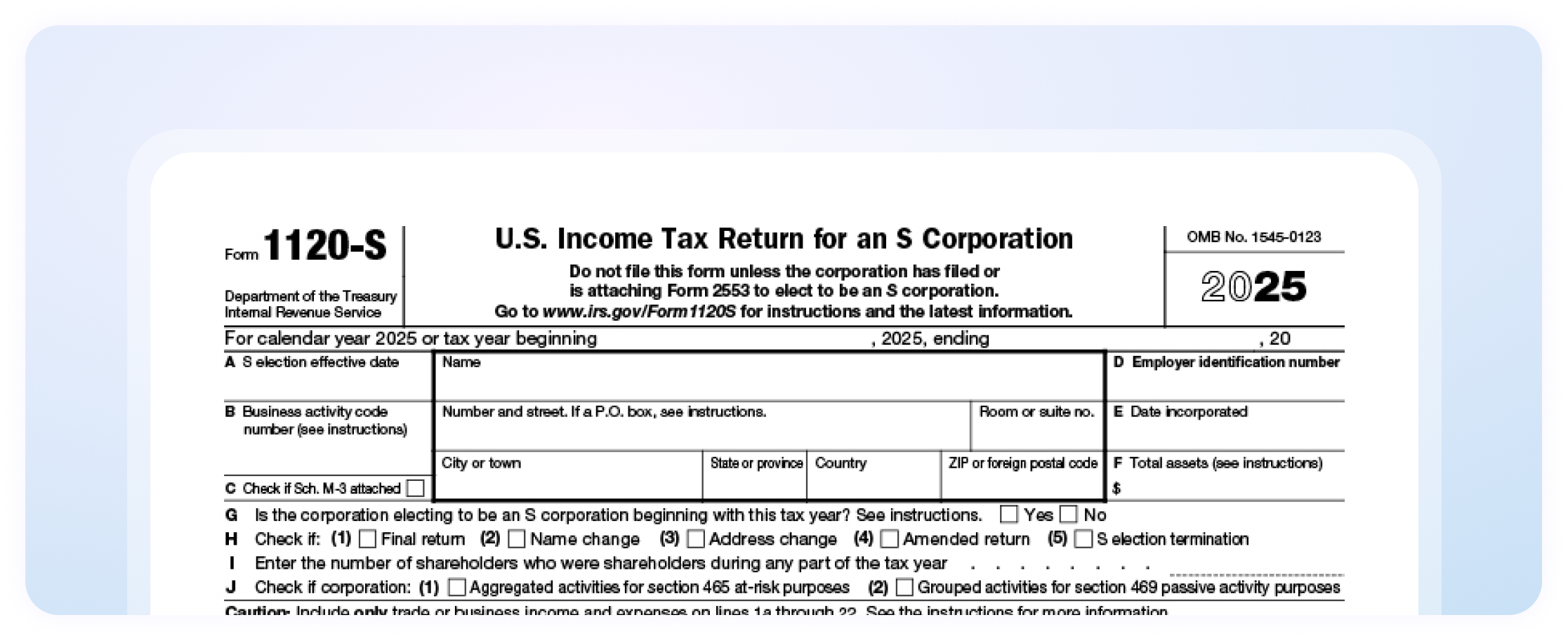
What is Form 1120-S?
Form 1120-S is the US Income Tax Return for S Corporations. It lets a corporation pass its income, losses, deductions, and credits through directly to its shareholders, rather than paying corporate income tax at the entity level. To file as an S Corporation, a company must have previously filed Form 2553 with the IRS and received approval.
Along with the main return, each shareholder receives a Schedule K-1 showing their individual share of the S Corp's income, deductions, and credits for the year. Inkle prepares K-1s for all shareholders as part of the filing.
.png)
Who can file Form 1120-S?
Form 1120-S applies to corporations that have made a valid S Corporation election with the IRS and whose election remains in effect for the tax year.

S Corporations with active operations
If your S Corp had revenue, expenses, and normal business activity during the year, Form 1120-S reports all of it, with income and deductions flowing through to shareholders via their Schedule K-1s.
S Corporations with no activity
If the S election was accepted and remains effective for the tax year, the corporation files Form 1120-S regardless of business activity. An inactive year does not cancel the filing obligation.
S Corps with multiple shareholders
Each shareholder's K-1 reflects their ownership percentage in the company. Inkle prepares a K-1 for every shareholder as part of filing the return.
Foreign-owned S Corporations
Nonresident aliens cannot be shareholders in an S Corporation. Eligible shareholders are limited to US citizens, resident aliens, certain trusts, and estates. A US citizen living abroad remains eligible and subject to the same filing rules.
Inkle makes filing Form 1120-S simple
We guide you through the Form 1120-S process in clear steps, surfacing exactly what your S Corporation needs to file.
A licensed CPA handles your Form 1120-S from start to finish, reviewing your intake, preparing the complete return, and filing it with the IRS.
Inkle prepares an individual Schedule K-1 for each shareholder alongside the main return, showing their share of the S Corp's income, deductions, and credits for the year.
A dedicated tax expert answers your shareholder and K-1 questions in Inkle chat, with no call to schedule.
Deadline
The deadline to file Form 1120-S is March 15 for calendar-year S Corporations, meaning S Corps whose tax year runs from January 1 through December 31. If you need more time, you can file for a six-month extension using Form 7004, which moves the deadline to September 15. There is no extension available beyond September 15.
Pro Tip
The penalty for a late S Corporation return is $220 per shareholder per month, starting from the original due date. A two-shareholder S Corp that files three months late owes $1,320 in penalties before any other tax considerations come into play. The penalty accrues from the original March 15 deadline, not from the extended deadline if you filed an extension.
.png)
FAQs
Form 1120-S is the annual federal income tax return for S Corporations. It reports the S Corp's income, deductions, gains, and losses to the IRS for the year, and it generates the Schedule K-1s that each shareholder uses when filing their own personal tax return. The S Corporation itself does not pay federal income tax on this return. The income passes through to the individual shareholders.
Form 1120 is the tax return for C Corporations, which pay corporate income tax at the entity level. Form 1120-S is the return for S Corporations, which are pass-through entities. The income reported on Form 1120-S flows through to each shareholder's personal return via Schedule K-1, and the S Corp itself pays no federal income tax. The two forms are for fundamentally different tax structures.
Any corporation that has made a valid S Corporation election with the IRS by filing Form 2553 and whose election remains in effect files Form 1120-S every year. If you have filed Form 1120-S in prior years, you continue to file it unless the S Corp election has been terminated.
March 15 for calendar-year S Corporations. If you filed for a six-month extension using Form 7004, the extended deadline is September 15. No further extension is available after that.
Yes. An S Corporation that had no revenue or activity during the year still needs to file a nil return. The IRS requires the filing regardless of whether the company was active. Skipping it results in the same failure-to-file penalty as skipping a return for an active company.
Schedule K-1 is the document each shareholder receives after Form 1120-S is filed. It shows their individual share of the S Corp's income, deductions, and credits for the year. Shareholders need their K-1 to file their personal tax return accurately. Inkle prepares a K-1 for every shareholder as part of the Form 1120-S filing.
The IRS charges $220 per shareholder per month for a late S Corporation return, starting from the original due date. A two-shareholder S Corp that files four months late owes $1,760 in penalties, separate from any other tax owed.
For nil filings, closed books are not required. For active S Corps, reach out and describe where your books stand. The CPA will tell you directly whether there is enough to work with before the deadline.

