How Can AI and SaaS Startups Access Non-Dilutive Capital Without Giving Up Equity



Equity used to be the default path for startups looking to grow fast. Raise a round, trade ownership for capital, and scale aggressively. But over the last few years, that approach has started to shift. Founders are now paying closer attention to capital efficiency, burn, and long-term ownership. Giving up equity early can compound over time, leaving founders with far less control than expected.
Dilution is not just about percentage ownership. It affects decision-making, board control, and future fundraising flexibility. For AI and SaaS startups, where margins and revenue predictability are improving, many founders are questioning whether every growth milestone needs to be funded through equity.
This is where non-dilutive capital comes in. It offers a way to access funding without giving up ownership, often aligned with revenue or specific use cases. Can you grow faster without raising another equity round? This guide breaks down how non-dilutive capital works, what options are available, and how to use it as a practical growth lever.
What Is Non-Dilutive Capital and When Should You Use It
Non-dilutive capital is funding that helps a startup grow without giving up equity. Instead of selling ownership to investors, the business gets access to capital through options such as revenue-based financing, venture debt, grants, or credit-based products. In most cases, this funding needs to be repaid, but the founder keeps ownership and decision-making power.
For AI and SaaS startups, this can be a strong fit when growth depends more on working capital than on long product development cycles. If a company already has paying customers, recurring revenue, or a clear path to revenue expansion, non-dilutive capital can help fund hiring, marketing, or product execution without forcing another priced round.
How Is Non-Dilutive Capital Different from Equity Funding
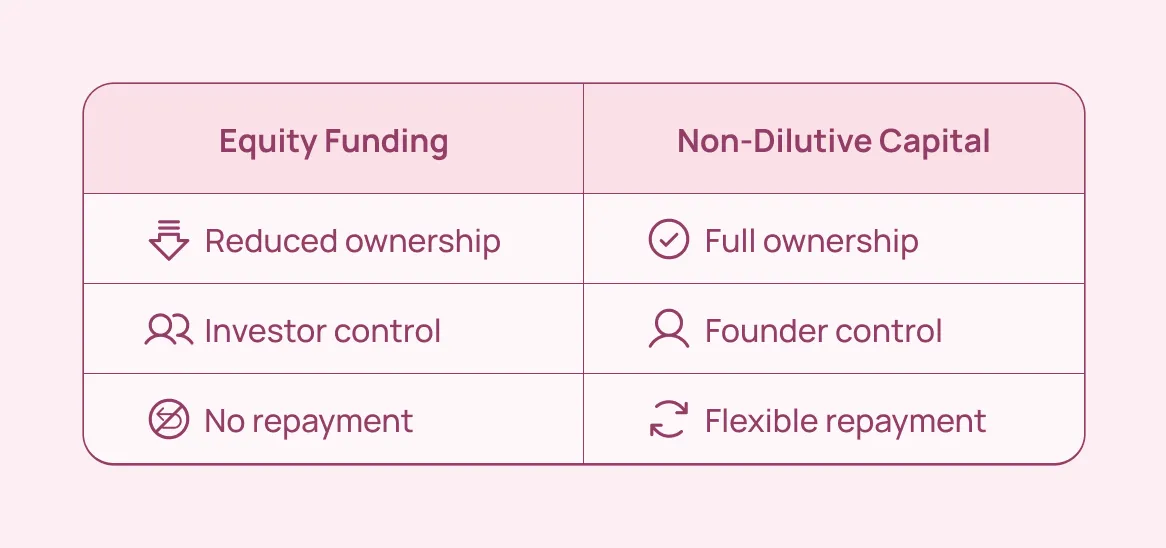
The biggest difference is ownership. Equity funding gives a portion of the company to investors in exchange for capital, which reduces the founder’s stake over time. Non-dilutive capital gives access to funding without changing the cap table. That means founders can keep more control over the company while still unlocking growth capital.
The tradeoff is repayment. Equity does not need to be repaid, but it comes with dilution and often more investor influence. Non-dilutive capital usually has repayment terms, eligibility criteria, and performance expectations. So the choice is not about which option is better in general. It is about which option fits the business at a given stage.
When Does It Make Sense for SaaS and AI Startups
This model makes sense when a startup has enough business visibility to handle repayment responsibly. SaaS startups with monthly recurring revenue, low churn, and stable customer growth are often good candidates. AI startups may also use it when they have enterprise contracts, predictable renewals, or recurring usage-based revenue.
It is also useful when founders want to delay dilution until the business reaches a stronger valuation. Instead of raising equity too early, they can use non-dilutive capital to hit the next milestone, improve revenue quality, and enter the next round from a better position.
What Non-Dilutive Funding Options Can AI and SaaS Startups Use
Non-dilutive capital is not a single product. It is a mix of financing options designed for different stages of growth and revenue maturity. The right choice depends on how predictable your revenue is, how fast you are growing, and whether you need flexibility or scale.
AI and SaaS startups rarely rely on just one option. Early-stage companies may start with grants or credits, then move to revenue-linked financing, and later use structured debt to extend runway. The key is to match the funding type with your current stage and cash flow profile.
The following sections detail various non-dilutive funding options, each suited to different stages of growth and revenue predictability for AI and SaaS startups:
i) Revenue-Based Financing for Early to Growth-Stage SaaS
Revenue-based financing works best when you have steady monthly recurring revenue. The facility size is typically deployed as a percentage of your ARR, giving you capital that's right-sized to your business. Unlike traditional debt, RBF carries a fixed fee rather than a variable interest rate — and repayments are structured to align with your revenue, making it easier to manage during slower months while still accessing capital to invest in growth channels like sales and marketing.
ii) MRR Lines of Credit for Scaling Subscription Businesses
MRR-based credit lines give you access to capital based on your recurring revenue base. You can draw funds when needed and repay flexibly, making this useful for managing working capital, hiring, or short-term expansion without locking into rigid repayment schedules.
iii) Venture Debt for Post-Series A Companies
Once you have raised equity and established some traction, venture debt becomes available. It is typically used to extend runway, fund large initiatives, or avoid raising equity too soon. Since it is structured as debt, it requires stronger financial discipline and clear repayment visibility.
iv) Grants and R&D Credits for AI and Deep Tech Startups
AI startups investing in research, infrastructure, or innovation can access government grants and R&D tax credits. These do not require repayment and are especially useful in early stages where revenue may not yet be predictable. They help offset costs while allowing founders to retain full ownership.
How Can You Build a Non-Dilutive Capital Strategy That Supports Growth
Accessing non-dilutive capital is one thing. Using it effectively is another. Many startups treat it as a one-time funding decision, but the real advantage comes from building a structured approach that aligns capital with growth milestones. This ensures you are not over-leveraging too early or under-utilizing available funding options.
For AI and SaaS startups, the strategy should be tied closely to revenue visibility and cash flow cycles. The goal is to use non-dilutive capital to accelerate predictable growth, not to cover uncertainty. When used well, it can extend runway, improve valuation for future rounds, and reduce pressure to raise equity prematurely.
Here are the metrics lenders evaluate before funding:
- Combine multiple funding sources based on your stage and capital needs instead of relying on a single option.
- Align repayment structures with your revenue cycles so cash flow remains stable during growth.
- Maintain accurate and up-to-date financial records to streamline approvals and demonstrate financial maturity to lenders.
How Inkle Scaled Without Dilution Using Non-Dilutive Capital
Inkle’s growth journey was not limited by demand. It was limited by timing. The business was seeing strong traction, but revenue did not flow evenly throughout the year. This created periods where capital was required to support growth, even though the underlying business was healthy.
Raising equity at that stage would have solved the short-term capital need, but it would have come at the cost of dilution. The team would have had to accept a valuation that did not fully reflect the company’s potential. Instead of moving quickly into another round, the focus shifted to finding a funding approach that aligned with how the business actually generated revenue.
What Challenge Did Inkle Face While Scaling
The core issue was not lack of growth but a mismatch between cash inflows and growth requirements. Inkle had predictable demand, but the timing of revenue created gaps when the company needed capital to continue scaling operations.
There was also increasing pressure to raise another equity round. This is common for startups at this stage, where growth signals are strong but not yet fully reflected in valuation. Raising at that point would have meant giving up a larger share of the company earlier than necessary.
At the same time, the team wanted to invest in growth areas such as customer acquisition, operations, and product improvements. Slowing down was not an option, but neither was giving up ownership too early.
What Solution Enabled Growth Without Dilution
Instead of relying on equity, Inkle explored non-dilutive financing options that could be structured around its revenue patterns. This allowed the company to access capital when needed without committing to a single large funding event.
The funding was designed to be flexible. Capital could be drawn in phases based on business needs, rather than being raised all at once. Repayments were aligned with revenue cycles, which reduced pressure during slower periods and made the model sustainable.
Another important shift was independence from external timelines. The team was no longer dependent on investor sentiment, valuation cycles, or market conditions. This gave them the freedom to focus on execution rather than fundraising.
Here are the results Inkle achieved: -
- The company avoided two planned equity rounds during key growth stages.
- Founders retained close to 90% ownership, preserving long-term control.
- Inkle scaled to support more than 500 companies across different markets.
- The team maintained full control over strategic decisions without external pressure.
Frequently Asked Questions
What is non-dilutive capital for SaaS startups
Non-dilutive capital is funding that allows startups to grow without giving up ownership. It is usually repaid over time or linked to revenue instead of equity.
When should a startup choose non-dilutive funding over equity
It makes sense when your business has predictable revenue and you want to scale while retaining ownership. It is also useful to delay dilution until you reach a stronger valuation.
Does non-dilutive capital affect company control
No, founders retain ownership and board control because no equity is issued as part of the funding.
What metrics are required to qualify for non-dilutive financing
Lenders typically evaluate revenue, churn, unit economics, and financial records to assess repayment capacity and stability.
Can early-stage startups access non-dilutive capital
Yes, early-stage startups can access grants, R&D credits, or early revenue-based financing options depending on their business model.
How does non-dilutive capital impact long-term growth
It supports growth without dilution, helping founders maintain ownership and improve their position for future fundraising rounds.