What Are the 1099 Filing Requirements for 2025–2026?
.webp)


If you pay contractors, vendors, or freelancers, 1099 filing is mandatory.
For US startups and cross-border teams, these forms connect contractor payments to IRS reporting and tax audits. A single missed form can raise questions about compliance, expense accuracy, and worker classification.
What happens if you miss a deadline or issue the wrong form? Penalties add up fast, and misclassification risks go beyond fines. With tighter IRS checks and mandatory e-filing rules now in place, are you confident your 1099 process is ready for 2025–2026?
Let’s find that out next.
Which 1099 Forms Do You Need to File?
Most businesses only deal with one or two 1099 forms, but choosing the wrong one is a common reason filings get flagged. The IRS separates non-employee compensation from other income types, and each category has its own form and rules.
If you pay contractors, landlords, or service providers, understanding where each payment belongs helps you avoid rework, penalties, and follow-up notices.
1. Form 1099-NEC
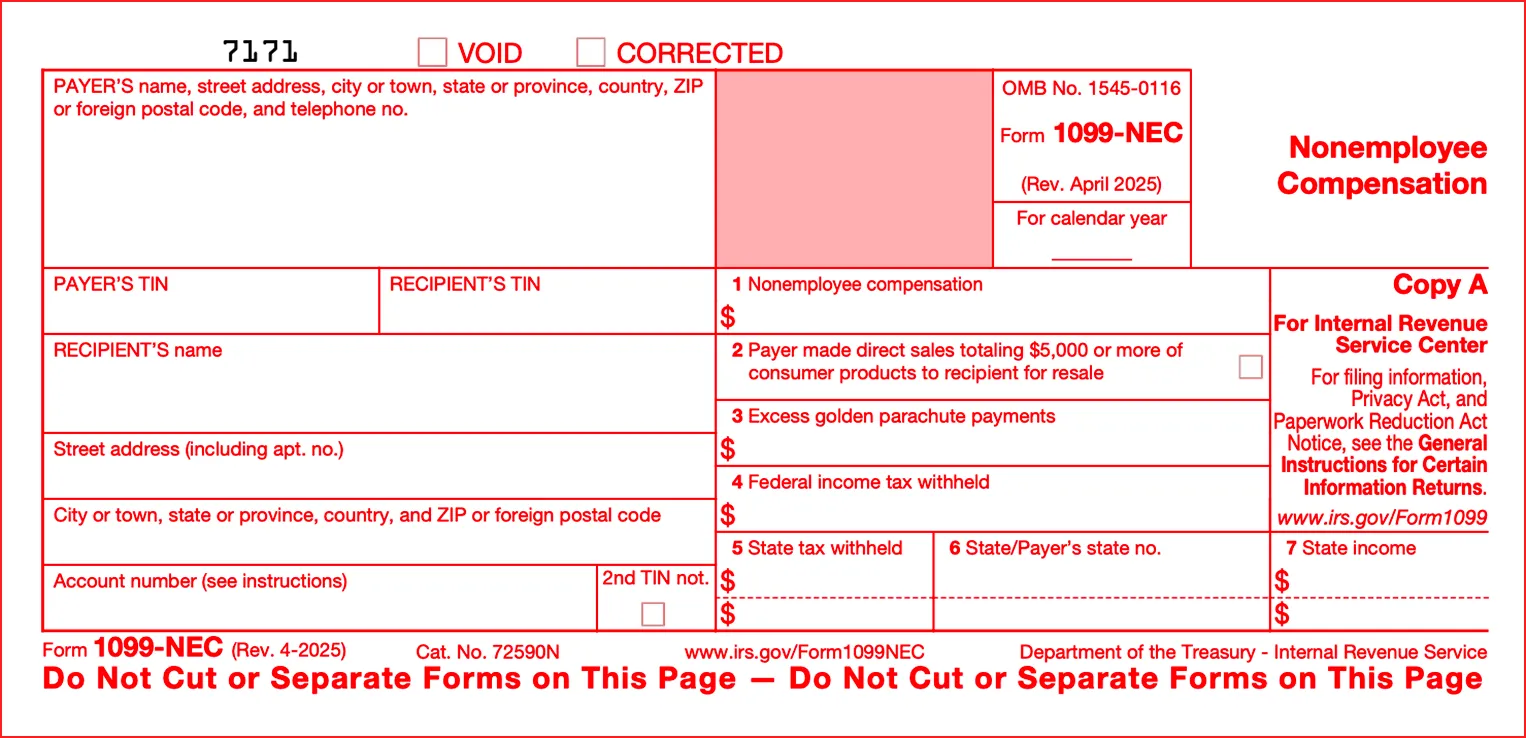
Form 1099-NEC is used to report payments made to non-employees for services. This includes freelancers, independent contractors, consultants, and agency partners who are not on your payroll. If you paid an individual or qualifying business for services during the year, this is usually the form you file.
The form applies when payments are made in the course of business, not personal transactions. Payments can be made by cash, check, ACH, or other direct methods. Credit card and third-party network payments are reported separately through Form 1099-K.
You must file Form 1099-NEC if all of the following apply:
- Total payments to the contractor are $600 or more in the calendar year.
- Payments were made for services, not goods or reimbursements.
- The contractor is not treated as an employee.
2. Form 1099-MISC
.webp)
Form 1099-MISC is used to report specific types of income that are not tied to service-based work. While it was once used for contractor payments, that role moved to 1099-NEC in recent years. Today, 1099-MISC covers payments that fall outside standard service compensation.
Common examples include rent paid to property owners, certain legal settlements, prizes or awards, and other miscellaneous income types. If the payment does not represent fees for services performed by a contractor, it likely belongs on this form.
Here are the key differences between 1099-NEC and 1099-MISC:-
Using the wrong form is one of the most frequent filing errors. Mapping each payment type correctly early in the year reduces last-minute fixes during filing season.
Form 1099 Filing Deadlines in 2026
Missing a 1099 deadline is one of the fastest ways to trigger IRS penalties. For 2026 filings, the IRS keeps firm dates for both recipients and the government, with limited flexibility.
For the 2025 tax year, most 1099 forms must reach contractors and the IRS by January 31, 2026. If you file on paper and the form type allows it, the IRS deadline extends to February 28, 2026. Electronic filings are due by March 31, 2026.
Visual suggestion: A simple timeline showing January 31 for recipients, February 28 for paper IRS filing, and March 31 for electronic IRS filing.
How Do Weekends and Holidays Impact IRS Deadlines?
If a deadline falls on a weekend or a federal holiday, the IRS moves it to the next business day. For example, if January 31 falls on a Sunday, forms are due on the following Monday. This adjustment applies to both recipient copies and IRS submissions, but only when the date officially conflicts with a non-business day.
Who Must File Form 1099 Electronically?
The IRS now expects most businesses to file 1099 forms online. What used to be an option is now a requirement for many startups, even those with small contractor lists.
What Is the 10-Form E-Filing Threshold?
You must e-file your 1099s if you file 10 or more information returns in total during the year. This count applies across all form types, not just 1099-NEC.
Forms that count toward the 10-form total include:
- All 1099 forms, including NEC, MISC, INT, and DIV
- W-2 forms issued to employees
- Any corrected or amended information returns
If your total reaches 10, paper filing is no longer allowed.
Visual suggestion: A decision flowchart that starts with total forms issued and ends with e-file required or paper allowed.
When Do You Still Need Form 1096?
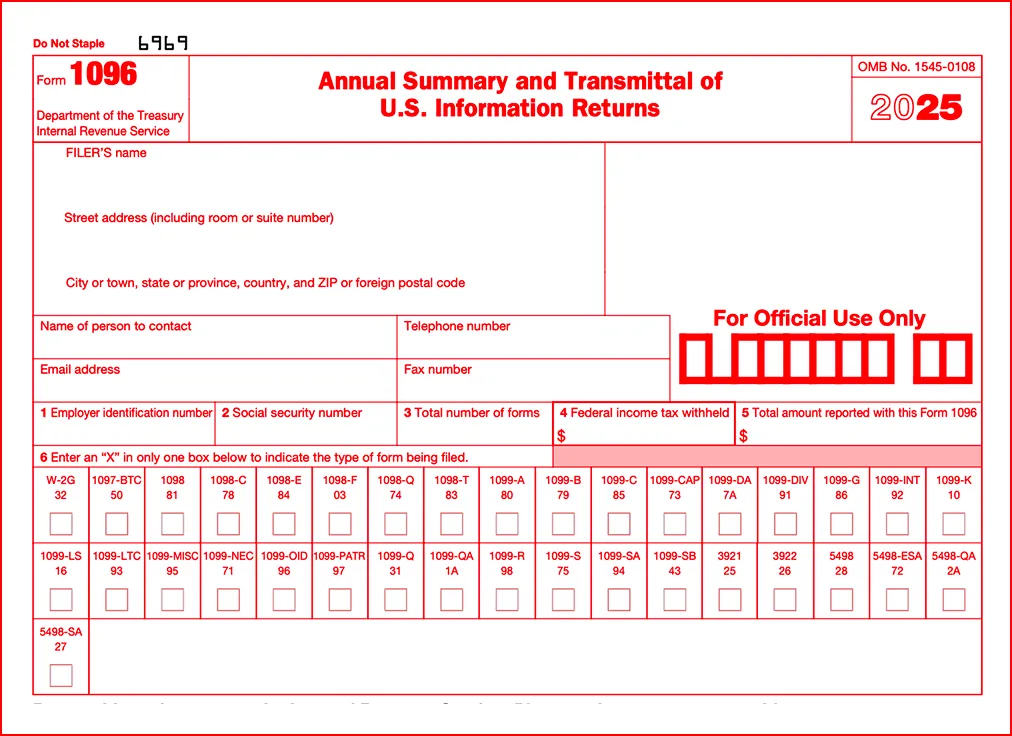
Form 1096 is only required if you file 1099 forms on paper. It acts as a summary cover sheet sent to the IRS along with physical forms. If you e-file, Form 1096 is not needed and should not be submitted.
Who Should Receive a Form 1099?
Not every vendor or payee needs a 1099. The rules depend on the contractor’s legal structure, the type of service provided, and how payments were made. Getting this wrong often leads to over-reporting or missed filings.
Are Corporations Required to Receive a 1099?
In most cases, payments made to corporations do not require a 1099. This applies to both C corporations and S corporations. Many startups assume all vendors need a form, which leads to unnecessary filings.
There are important exceptions. Payments to attorneys must be reported, even if the law firm is incorporated. Certain medical and healthcare payments also require reporting, regardless of entity type. Checking the vendor’s W-9 early helps confirm whether a 1099 is required.
How Should You Report Payments to Contractors?
Contractor payments should only be reported if the worker meets the IRS criteria for non-employees. This depends on control, independence, and how the work relationship is structured.
Visual suggestion: A checklist comparing contractor and employee traits, such as control over work hours, use of own tools, and ability to work with multiple clients.
What Changed in 2025–2026 regarding Form 1099 filing?
The IRS did not overhaul the 1099 system, but enforcement and reporting expectations continue to tighten. For startups and cross-border teams, these changes affect how early you collect data and how closely you track payment flows.
1099-K Reporting Threshold Updates
The IRS again delayed the full rollout of the $600 1099-K threshold for third-party payment platforms. For 2025 filings, higher transitional thresholds still apply, which means fewer businesses receive 1099-K forms from payment processors.
That said, payment method still matters. Amounts reported on a 1099-K should not be duplicated on a 1099-NEC or 1099-MISC. Businesses must reconcile platform reports carefully to avoid double reporting.
Will Non-Employee Compensation Rules Change Again?
The IRS continues to focus on worker classification and payment accuracy. While the form itself is unlikely to change soon, enforcement activity around misclassified contractors is increasing.
This means clean W-9 collection, consistent payment tracking, and correct form selection matter more than ever. Startups that rely on contractors across borders should expect closer scrutiny, not looser rules.
Penalties for Late or Incorrect Form 1099 Filing
1099 mistakes rarely stay small. A late or incorrect filing can trigger IRS notices, penalties per form, and follow-up requests that consume time during an already busy close cycle.
The IRS applies penalties per form, based on how late the correction or filing occurs.
Penalties apply separately for failing to send forms to contractors and failing to file with the IRS.
How Inkle Helps You File 1099s Accurately?
Inkle takes the manual work out of 1099 compliance by connecting your books, vendor data, and filing workflows in one place. Contractor payments are tracked throughout the year, mapped to the correct 1099 form, and validated against IRS rules before filing. This reduces last-minute scrambling, mismatches, and rework during January.
For US startups and other cross-border teams, Inkle handles the added layers of compliance. You can manage US contractor reporting alongside global vendor data, collect and store W-9s, and e-file directly with the IRS. Built-in checks flag missing information, threshold issues, and form selection errors before submission.
Book a demo and start your form 1099 filing with Inkle today. Handle contractor tax forms on time and error-free with Inkle’s automated compliance tools.
Frequently Asked Questions
1. What is the minimum threshold to file a 1099-NEC?
You must file Form 1099-NEC if you pay $600 or more to a non-employee for services in a calendar year.
2. Do I need Form 1096 if I e-file my 1099s?
No. Form 1096 is only required when you submit paper 1099 forms to the IRS.
3. When does a business have to e-file 1099s instead of mailing them?
If you file 10 or more total information returns, including W-2s and all 1099 types, e-filing is mandatory.
4. Can I issue a 1099 to a corporation?
Usually no. Exceptions apply for legal services and certain medical or healthcare payments.
5. What is the deadline to send 1099 forms to contractors in 2026?
January 31, 2026, for most 1099-NEC and 1099-MISC forms.
6. What happens if I miss the 1099 filing deadline?
The IRS may charge penalties ranging from $60 to $310 per form, depending on how late you file.


.svg)
