Delaware Franchise Tax: What It Is, How to File, and Why We're Making It Free


If you incorporated in Delaware (like most startups do), there's one annual obligation you can't ignore: the Delaware Franchise Tax.
It's not the most exciting part of running a startup, but it's unavoidable. Miss the deadline, and you'll face penalties. Overpay, and you've wasted money you could've spent on growth.
The good news? It doesn't have to be complicated or expensive. Here's everything you need to know about Delaware franchise tax, and how Inkle is making filing completely free.
File your Delaware franchise tax for free → delawarefiling.com
We're doing this because we want to help more founders stay compliant. And frankly, we want to introduce you to Inkle. If you need ongoing help with bookkeeping, taxes, or compliance down the road, we'd love to work with you. But even if you don't, your filing is still free.
Here's everything you need to know about Delaware franchise tax—and how our free filing works.
What is Delaware Franchise Tax?
Delaware franchise tax is an annual fee that all Delaware corporations must pay for the privilege of being incorporated in the state. It is not based on income or profits; instead, it is calculated using your company’s shares and assets.
Key facts:
- Who pays it: All Delaware corporations (C-corps and S-corps). LLCs pay a flat annual tax instead.
- When it's due: March 1st every year
- What happens if you miss it: Penalties start at $200 and increase monthly, plus interest of 1.5% per month
- Cost: Varies wildly based on your calculation method. Anywhere from $175 to tens of thousands of dollars
Why do so many startups incorporate in Delaware?
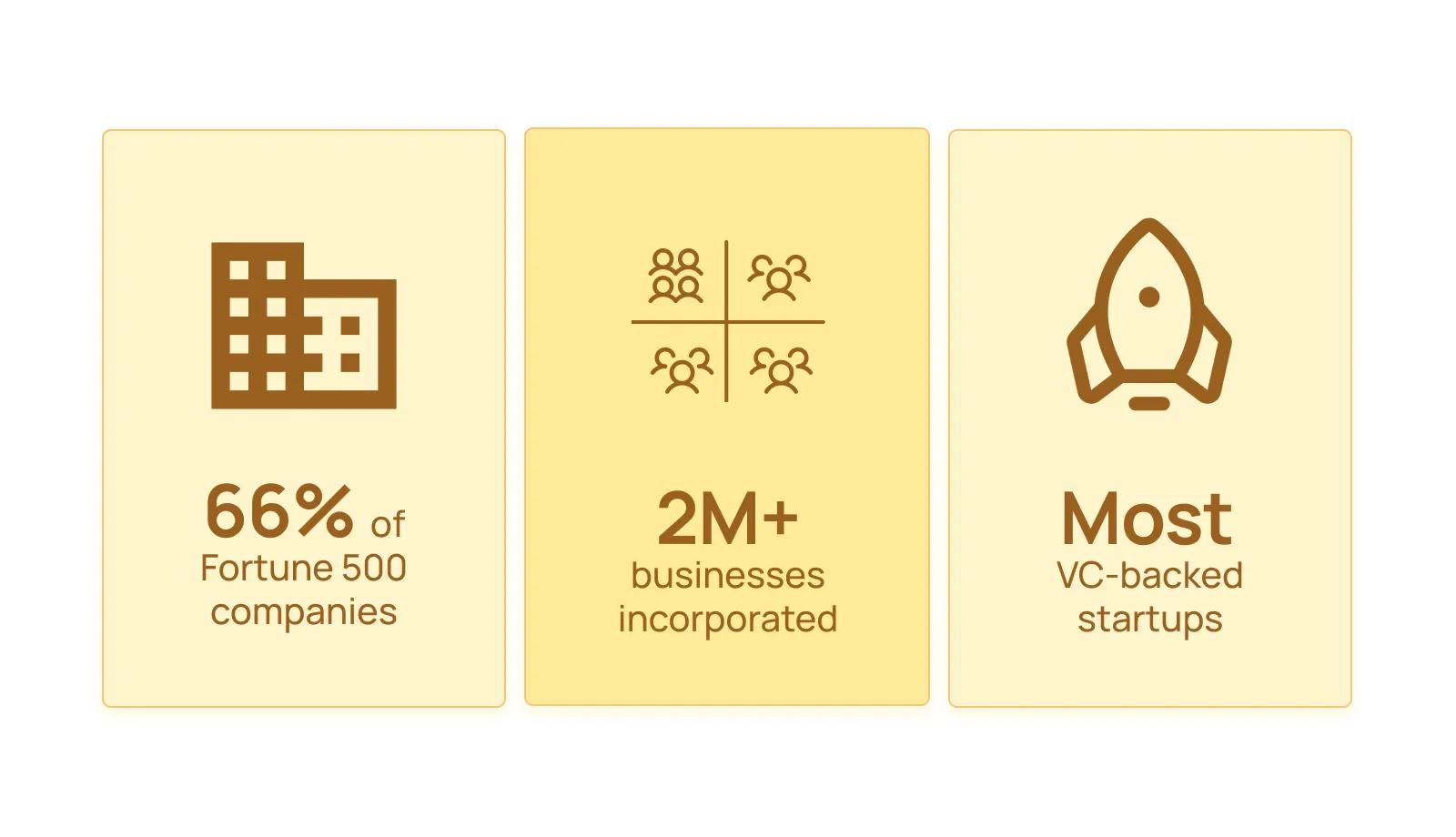
Over 2 million businesses are incorporated in Delaware, including more than 66% of Fortune 500 companies and the majority of venture-backed startups.
Here's why:
Established corporate law: Delaware has 200+ years of corporate case law, making legal outcomes more predictable for investors and founders.
Business-friendly courts: The Delaware Court of Chancery specializes in corporate disputes and doesn't use juries, leading to faster, more expert decisions.
Investor preference: Most VCs insist on a Delaware incorporation. It's the standard, and deviating from it could raise red flags.
Flexibility: Delaware law gives companies more flexibility in structuring governance, stock classes, and director protections.
How is Delaware Franchise Tax calculated?
This is where it gets tricky. Delaware gives you two methods to calculate your tax, and you're allowed to pick whichever results in a lower amount:
Method 1: Authorized Shares Method
Based on the number of shares your company is authorized to issue (not how many you've actually issued).
Minimum: $175
Maximum: $200,000
This method can get expensive fast if you authorized a large number of shares when you incorporated.
Method 2: Assumed Par Value Capital Method
Based on your company's total gross assets and issued shares.
This method usually results in lower taxes for early-stage startups with few assets, but requires more calculations. The minimum tax using this method is $400, with a maximum of $200,000.
Most founders don't know which method to use, so they either:
- Overpay by using the wrong calculation
- Spend time and money hiring someone to figure it out
- Stress about whether they did it right
What you need to file
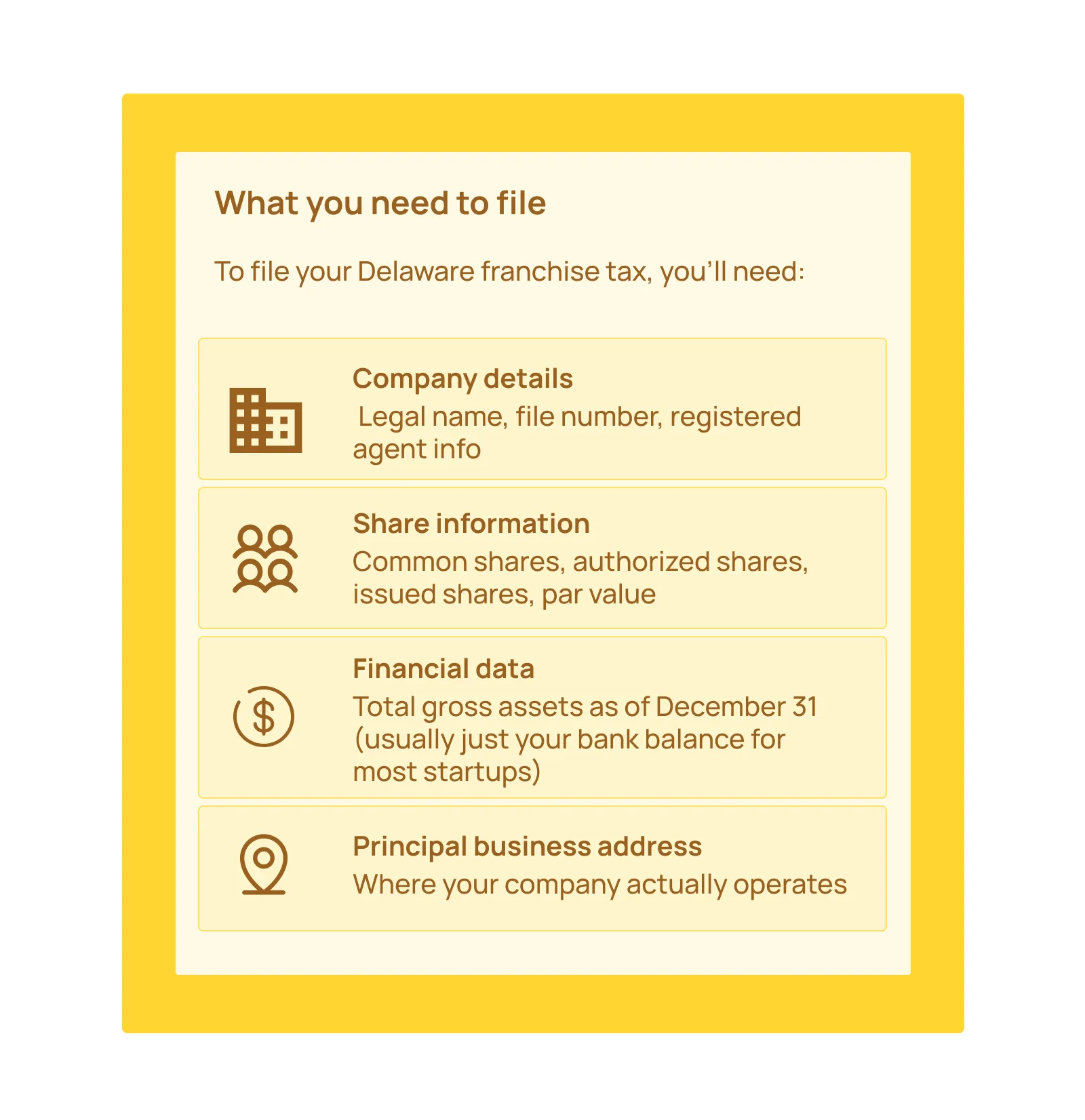
To file your Delaware franchise tax, you'll need:
- Company details: Legal name, file number, registered agent info
- Share information: Common shares, authorized shares, issued shares, par value
- Financial data: Total gross assets as of December 31 (usually just your bank balance for most startups)
- Principal business address: Where your company actually operates
Once you have this info, you file through Delaware's Division of Corporations and pay the calculated amount.
Common mistakes founders make
- Missing the deadline: March 1st comes faster than you think. Late fees start at $200 and climb from there.
- Using the wrong calculation method: Many founders default to the authorized shares method and end up paying way more than necessary.
- Not updating their registered agent: If Delaware can't reach you, you won't get important notices, and you might miss your filing window.
- Guessing at gross assets: You need an accurate number as of December 31. "Close enough" doesn't cut it if you get audited.
- Forgetting to file the Annual Report: The franchise tax payment must be accompanied by an Annual Report. You can't just pay—you have to file too.
Why we're offering free filing
At Inkle, we work with 500+ startups on bookkeeping and compliance. We've helped file hundreds of Delaware franchise taxes, and we've seen how unnecessarily stressful and expensive it can be for founders.
So we're making it free.
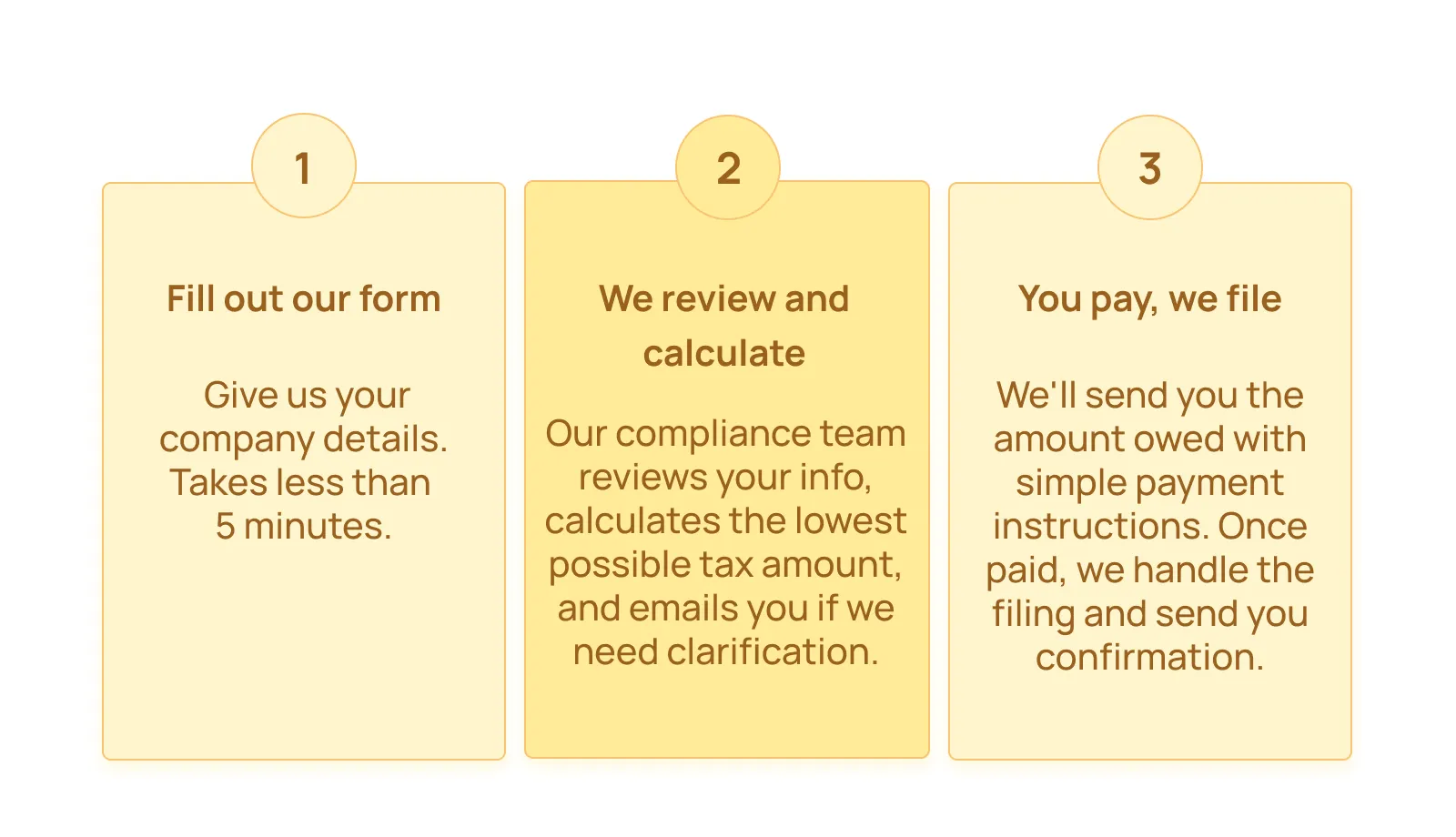
Here's how it works:
- Fill out our form: Give us your company details. Takes less than 5 minutes.
- We review and calculate: Our compliance team reviews your info, calculates the lowest possible tax amount, and emails you if we need clarification.
- You pay, we file: We'll send you the amount owed with simple payment instructions. Once paid, we handle the filing and send you confirmation.
No catch. No credit card required. No automatic subscriptions.
Filing for multiple companies?
If you're an accountant or bookkeeper managing DFT filings for multiple clients, we've built a bulk filing option. Download our spreadsheet template, add all your clients' details, upload it, and we'll handle the rest—still completely free.
Learn more about bulk filing → delawarefiling.com/bulk-filing
Get started
Delaware franchise tax doesn't have to be a headache. Whether you're filing for one company or fifty, we're here to help.
File your Delaware franchise tax for free → delawarefiling.com