What is Nexus in Taxation? How It Impacts Multi-State Compliance?



Selling across the U.S. used to be simple. You operated in one state, filed taxes there, and moved on.
That model no longer applies to most startups. Remote teams, digital products, and nationwide customers mean your business can trigger tax obligations in multiple states without opening a single office.
This is where nexus comes in. Nexus defines whether a state has the right to tax your business. The tricky part is that this connection is not limited to physical presence anymore. Revenue thresholds, employee locations, and even customer distribution can create obligations you did not plan for. Could your business owe taxes in a state where you have never operated physically?
Questions this article answers:
- What is nexus tax meaning in simple terms
- What creates a tax obligation in another state
- How do physical and economic nexus differ
- What thresholds trigger tax liability
- How does nexus affect startups operating across states
- How can you track and manage multi-state compliance
What Does Nexus Tax Mean and Why Should Startups Care
Nexus is the threshold that decides where your business becomes taxable. It is not about where you are incorporated. It is about where you operate, earn revenue, or create economic activity. Once that connection exists, the state can require you to register, file returns, and pay taxes.
For many startups, this creates a mismatch between how they think about their business and how tax authorities view it. You might be a Delaware C-Corp with no office outside one state, but your customer base, employees, or contractors could quietly create obligations elsewhere. This is exactly how multi-state compliance starts without founders realizing it.
How Nexus Actually Works in Practice
Nexus is not triggered by a single universal rule. Each state defines its own thresholds, but the principle stays consistent. If your business has enough activity in a state, that state can tax you.
This activity can take different forms:
- A team member working remotely from another state
- Revenue generated from customers located in that state
- Inventory stored in warehouses or fulfillment centers
- Ongoing business relationships such as contractors or partners
The important detail here is that nexus is not optional once triggered. You do not choose where to comply. Your business footprint decides that for you.
Why Nexus Becomes a Real Issue as You Scale
Nexus rarely shows up on day one. It builds as your company grows and expands across geographies. The challenge is that it compounds silently.
- You hire your first remote employee and create tax exposure in a new state
- Your SaaS product crosses revenue thresholds in multiple states
- You expand operations without tracking where filings are required
At that point, compliance is no longer about a single federal return. It becomes a mix of federal, state, and sometimes international filings, each with its own deadlines and penalties.
What Creates Nexus for Your Business
Most founders expect nexus to be tied to something obvious like an office or incorporation. In reality, it is triggered by everyday business activity. As your company grows, small operational decisions start adding up across states, and each one can create a new compliance requirement.
The shift after the South Dakota v. Wayfair ruling made this even more complex. States no longer need a physical presence to impose taxes. Economic activity alone can now create nexus, which is why many startups discover obligations only after they scale.
Common Physical Presence Triggers You Might Overlook
Physical presence still remains one of the clearest ways nexus is created. The challenge is that “presence” is broader than just having an office.
- An employee or founder working remotely from another state
- Contractors operating regularly within a state
- Inventory stored in warehouses, including third-party fulfillment services
- Attending trade shows, events, or client meetings frequently
- Owning or leasing property, equipment, or servers
Even one of these can be enough. For example, hiring a single employee in California can trigger state tax obligations and minimum franchise tax requirements, regardless of your revenue.
How Economic Nexus Expands Your Tax Exposure
Economic nexus focuses on how much business you do in a state rather than where you are physically located. This is where most SaaS and internet businesses get caught off guard.
- Revenue thresholds, often around $100,000 in annual sales
- Transaction thresholds, such as 200 or more sales in a state
- State-specific variations in rules and calculation methods
- Applicability to digital products, subscriptions, and SaaS
This means you can create nexus simply by selling successfully into a state. No employees, no office, no physical footprint required.
The practical takeaway is simple. If your startup sells across the U.S. or hires remotely, you are likely creating nexus in more than one state already.
Compare Physical and Economic Nexus Side by Side
At a high level, physical and economic nexus answer the same question: does a state have the right to tax your business? The difference lies in what creates that connection. Physical nexus is tied to where you operate. Economic nexus is tied to how much you sell.
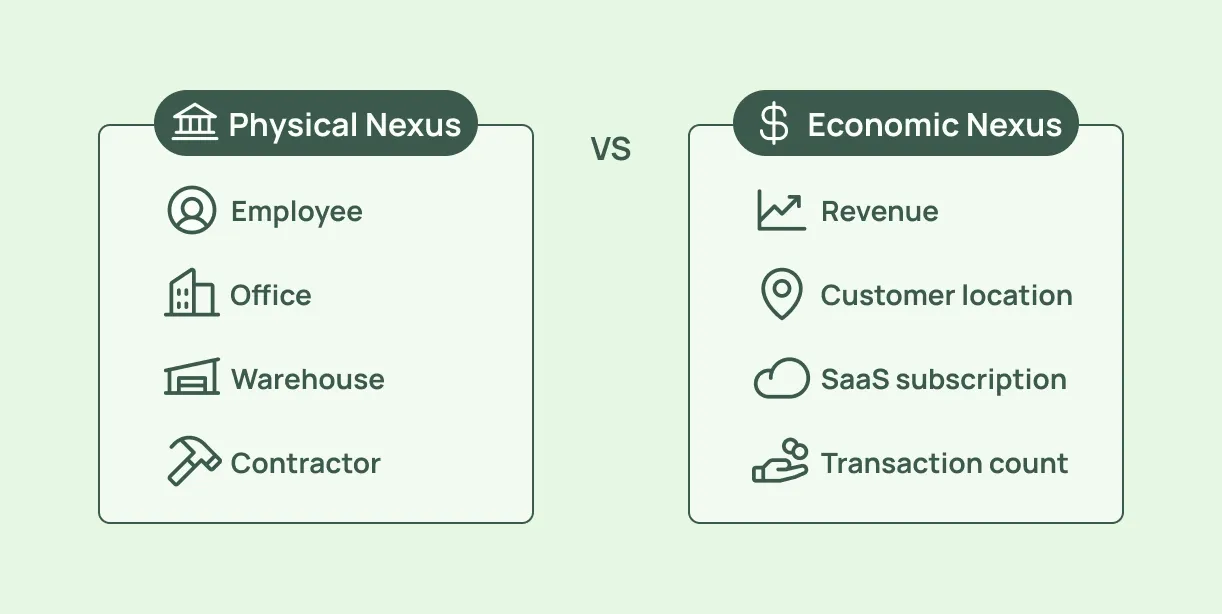
For startups, both can apply at the same time. You might trigger physical nexus in one state through a remote employee and economic nexus in another through revenue alone. This overlap is what makes multi-state compliance harder to track as you grow.
The key difference is timing. Physical nexus can start immediately with a single action like hiring an employee. Economic nexus builds over time and may only become visible after you cross thresholds.
In practice, most growing startups deal with both. Ignoring either side usually leads to missed filings, backdated tax exposure, and penalties that show up later during audits or fundraising.
Distinguish Between Sales Tax Nexus and Income Tax Nexus
Once nexus is created, the next question is not just where you owe taxes, but what kind of taxes apply. Many founders assume nexus only affects sales tax, but that is only one part of the picture. The same activity can trigger multiple tax obligations depending on how a state applies its rules.
For startups, this distinction matters because sales tax and income tax follow different logic, filing processes, and timelines. Missing one while tracking the other is a common mistake, especially as operations expand across states.
When You Need to Collect and Remit Sales Tax
Sales tax nexus determines whether you must collect tax from customers in a state and remit it to that state.
This typically applies when:
- You sell taxable products or services to customers in that state
- You cross economic thresholds such as revenue or transaction limits
- You have physical presence like inventory or employees
For SaaS companies, this gets more complex because taxability varies by state. Some states tax SaaS as a digital service, while others do not. That means nexus alone does not create liability, but it does create the obligation to evaluate and comply.
When Your Business Profits Become Taxable in Another State
Income tax nexus determines whether a state can tax your business profits. This includes corporate income tax or franchise taxes depending on the state.
You may trigger this when:
- You have employees, founders, or contractors working in a state
- You generate revenue that meets economic nexus thresholds
- You are considered to be “doing business” under that state’s rules
Some states impose minimum franchise taxes regardless of profitability — distinct from income tax, which is profit-based. For example, certain states require a fixed annual tax even if your business is operating at a loss.
The important takeaway is that nexus is not a single compliance checkbox. It creates multiple obligations, and each one needs to be tracked separately as your business grows.
How Key States Apply Nexus Rules Differently
Nexus rules are not applied uniformly across the U.S. Each state defines its own thresholds, tax types, and interpretation of what counts as “doing business.” This is where many startups run into trouble. You might correctly identify that you have nexus, but still misjudge what filings or taxes apply in that state.
Understanding a few high-impact states gives you a practical view of how different these rules can be in real scenarios.
i) California
California is one of the most aggressive states when it comes to nexus. A single employee, contractor, or even a founder working from California can create tax obligations. Once triggered, the state imposes a minimum franchise tax of $800, even if your business has no revenue or is operating at a loss.
This makes California a common source of unexpected tax exposure for remote-first startups. Many founders discover this only after hiring their first employee in the state.
ii) New York
New York applies both physical and economic nexus rules and often adds another layer of complexity through city-level taxes. If your business operates in New York City, you may need to file separate city taxes in addition to state-level corporate taxes.
For startups with customers or operations in New York, this can quickly turn into multiple filings from a single market presence.
iii) Texas
Texas does not have a traditional income tax, but it applies a franchise tax based on revenue, not profit. This means even startups that are not yet profitable may still have filing obligations.
There is a revenue threshold below which no tax is owed, but companies are still required to file a “no tax due” report. Missing this filing can still lead to penalties, which often surprises founders who assume no tax means no compliance.
iv) Washington
Washington follows a gross receipts tax model, often referred to as the B&O tax. Instead of taxing profit, the state taxes revenue directly. This can significantly impact startups with high revenue but thin margins.
For SaaS companies or marketplaces, this model changes how you think about tax liability because expenses are not deductible under this system.
v) Massachusetts
Massachusetts has been increasingly assertive in applying nexus rules to remote and digital businesses. Companies with employees, contractors, or even consistent customer activity in the state may trigger tax obligations.
For remote-first startups, this means nexus can exist even without a formal office or incorporation in the state. As teams become more distributed, Massachusetts is often one of the states that comes into play earlier than expected.
How Nexus Expands Your Compliance Workload
Once nexus is created in more than one state, tax compliance stops being a single annual task. It becomes an ongoing system of registrations, filings, deadlines, and reconciliations across jurisdictions. What starts as one federal return can quickly turn into five or more filings depending on where your team and customers are located.
This shift is where most startups feel the real impact. The effort is not just in filing returns, but in tracking obligations correctly across states, each with its own rules, formats, and timelines.
Here’s how Single-State and Multi-State filing requirements compare:-
As you expand, the number of filings increases linearly, but the complexity grows much faster. Each additional state introduces new rules, thresholds, and filing formats that need to be managed independently.
Hidden Costs of Multi-State Compliance
Beyond filing returns, nexus introduces ongoing operational costs that are easy to miss early on:
- Registration and annual fees in each state where nexus exists
- Recurring compliance work including bookkeeping alignment and reconciliations
- Increased accounting complexity, especially when allocating revenue and expenses across states
These costs do not always show up immediately, but they compound as your business grows. Without a structured system to track nexus and filings, startups often end up reacting late, leading to backdated filings and penalties.
Step by Step to Determine If Your Business Has Nexus
By this point, the question is practical. Do you actually have nexus, and where? This is not something you figure out once a year during tax season. It needs a simple, repeatable process that you can revisit as your business grows.
Most startups do not fail to comply because they do not want to. They miss it because there is no structured way to evaluate exposure across states. A clear checklist solves that.
Follow this Nexus Evaluation Checklist:-
Step 1 - List every state where you operate or sell
Include customer locations, employee locations, contractor activity, and any place where revenue is generated. This gives you your starting footprint.
Step 2 - Check for physical presence triggers
Review where your team is based, where inventory is stored, and where you conduct regular business activity. Even a single employee can create nexus in a state.
Step 3 - Review economic thresholds for each state
Look at revenue and transaction volumes state by state. Compare them against common thresholds such as $100,000 in sales or 200 transactions, keeping in mind that rules vary.
Step 4 - Assess which taxes apply in each state
Identify whether you need to handle sales tax, income tax, franchise tax, or a combination. Nexus does not create a single obligation, it creates multiple.
Step 5 - Register and plan your filings
Once nexus is confirmed, register in that state, note deadlines, and build a filing calendar. This prevents last-minute compliance issues and penalties.
Avoid Penalties by Staying Compliant with Nexus Rules
Nexus issues rarely hurt you immediately. They build quietly in the background and show up later when stakes are higher, during an audit, a fundraising round, or due diligence. By that time, the problem is no longer about filing one missed return. It becomes a question of how many years and how many states you need to fix.
States can go back and assess taxes from the point where nexus first existed. That means unpaid taxes, interest, and penalties all stack together. In some cases, even if your business was not profitable, you may still owe minimum taxes or filing penalties.
The operational impact is just as real. Investors and acquirers look closely at compliance. Gaps in filings or unclear tax exposure can slow down deals or reduce confidence in your financial discipline. Something that started as a small oversight can turn into a negotiation point later.
The pattern is consistent across startups. Nexus is easy to ignore early, but expensive to fix later. Staying ahead of it is less about perfection and more about having visibility and acting on it in time.
How Inkle helps Founders Manage Multi State Tax Compliance Efficiently
Once your business starts operating across states, the real challenge is not identifying nexus. It is staying on top of everything that follows. Registrations, filing deadlines, tax types, and state-specific rules all need to be tracked continuously, not just during tax season.
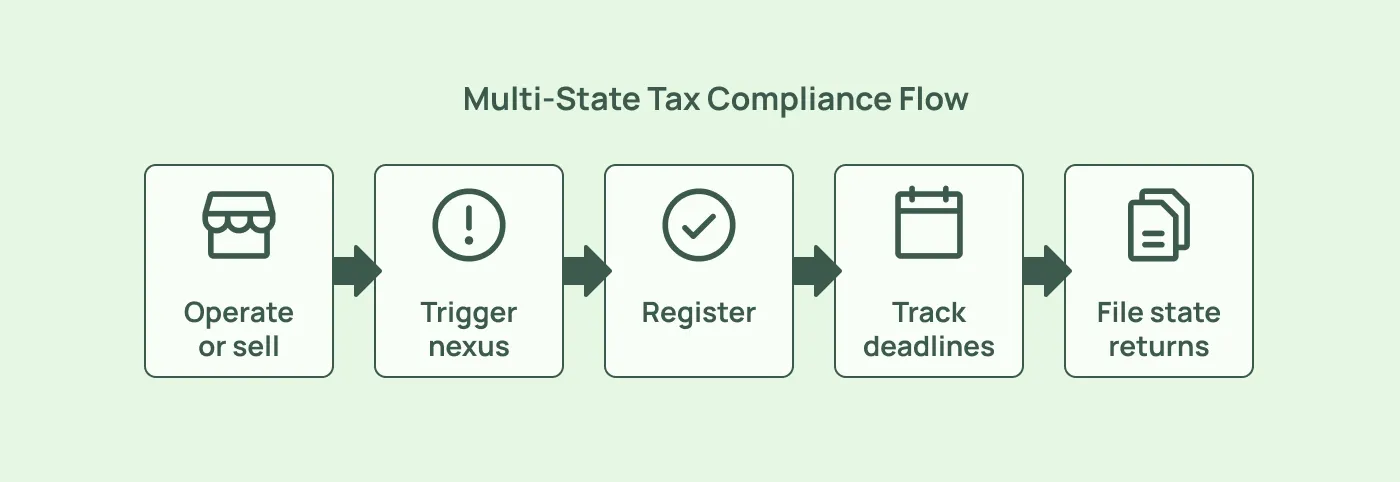
This is where most founders struggle. Compliance becomes fragmented across spreadsheets, tools, and advisors, with no single view of what is due and where. As operations scale, this fragmentation leads to missed filings, duplicated effort, and last-minute fixes.
Inkle is built to solve this exact problem for startups operating across borders and multiple states. Instead of treating bookkeeping and tax as separate workflows, it brings them together so your compliance is always based on clean, up-to-date financial data.
With Inkle, you can:
- Track state-wise tax obligations and upcoming deadlines in one place
- Maintain accurate books that feed directly into tax filings
- Identify nexus exposure early as your business expands
- Manage cross-border operations
The goal is simple. Give founders clarity on where they need to comply and remove the manual effort of tracking it across systems.
If you want a clear view of where your business stands and what you actually need to file, book a demo with Inkle. The team will walk you through your nexus exposure, filings, and a clean compliance setup tailored to your structure.
Frequently Asked Questions
Does hiring a remote employee in another state create nexus?
Yes, in most cases it does. A single employee working from a state is usually enough to create physical nexus and trigger tax obligations in that state.
What are common economic nexus thresholds across states?
Many states use thresholds like $100,000 in annual revenue or 200 transactions. However, these limits vary, so you need to check state-specific rules.
Do SaaS companies need to worry about nexus rules?
Yes. Even without physical presence, SaaS companies can trigger economic nexus through customer revenue. Taxability of SaaS also varies by state.
How do you register for taxes after creating nexus?
You typically need to register with the state’s tax authority, obtain relevant tax IDs, and start filing returns based on that state’s deadlines.
Can a business have nexus in multiple states at once?
Yes. It is common for growing startups to have nexus in several states at the same time, especially with remote teams and nationwide customers.
What happens if you ignore nexus requirements?
States can assess back taxes, penalties, and interest for past periods. These issues often surface during audits or fundraising.
How can startups track nexus without a full finance team?
Start with a simple tracking system that monitors employee locations and revenue by state. As complexity grows, using a structured tool or service helps avoid missed obligations.